
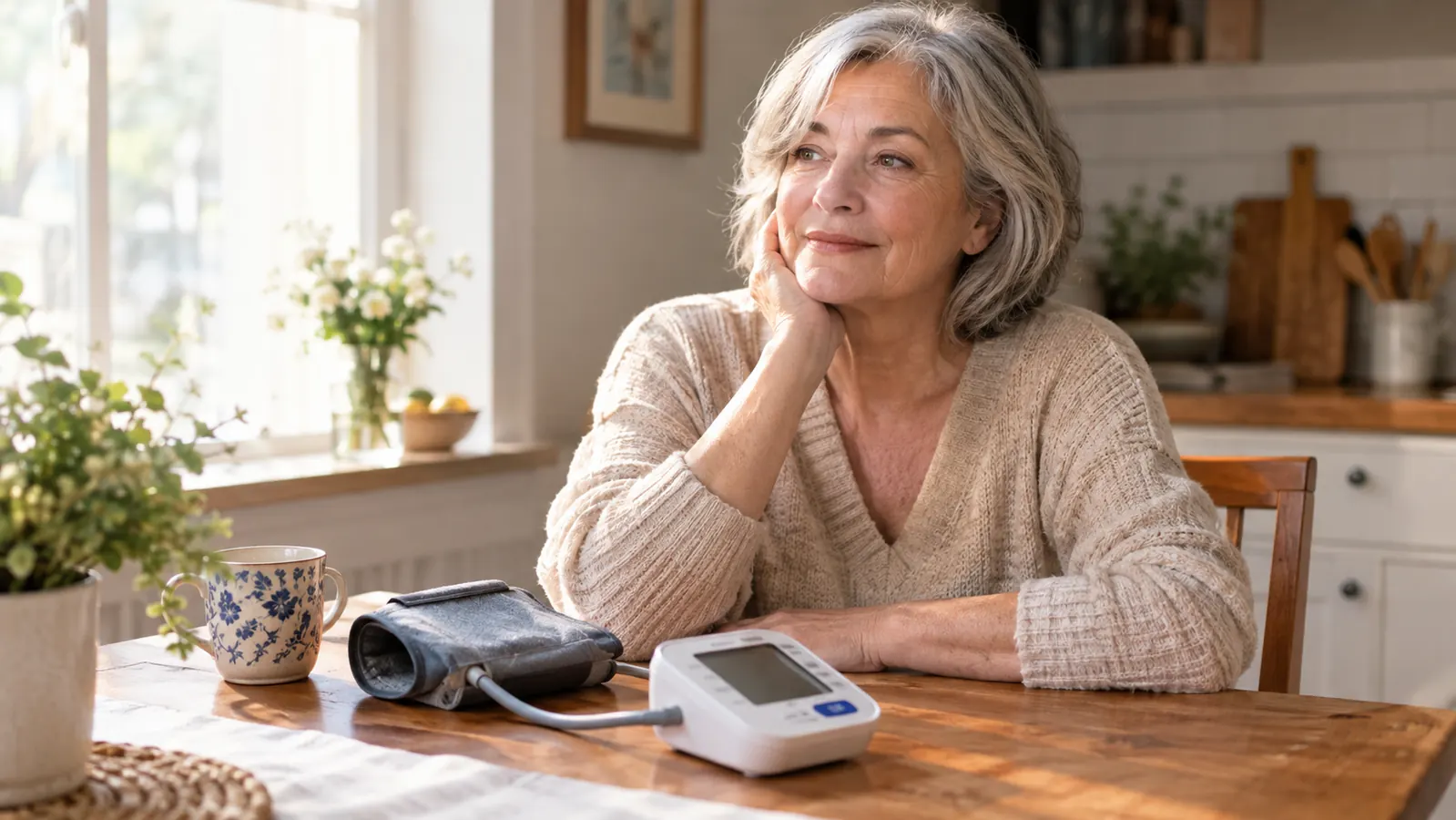
My doctor asked me to take readings at home twice a day for a few weeks and bring in a log. That was about two and a half years ago, and I am still doing it. The monitor I reach for most mornings is the Omron Bronze, an upper-arm blood pressure monitor with a 9 to 17 inch cuff. I have used it nearly every day since I bought it, and this is the long-term review I wish I had found before I started.
I am not a doctor or a nurse. I am a retired middle-school librarian in Round Rock, Texas, and I am only telling you what it is like to live with this monitor. Your own doctor is the one who interprets your numbers and decides on treatment. A monitor measures. It never treats or lowers anything, and I never imply otherwise.
The Quick Verdict
Two years in, the Omron Bronze is still the monitor I trust for my morning reading: simple, consistent, and easy to read. It is not fancy, and the memory is small, but it does the one job that matters day after day.
Amazon Check Today's Price →Two years of steady readings, one simple monitor
If you want a straightforward upper-arm monitor for daily home readings, the Omron Bronze is the one I still reach for at the kitchen table.
Amazon Check Today's Price on Amazon →How I've Used It
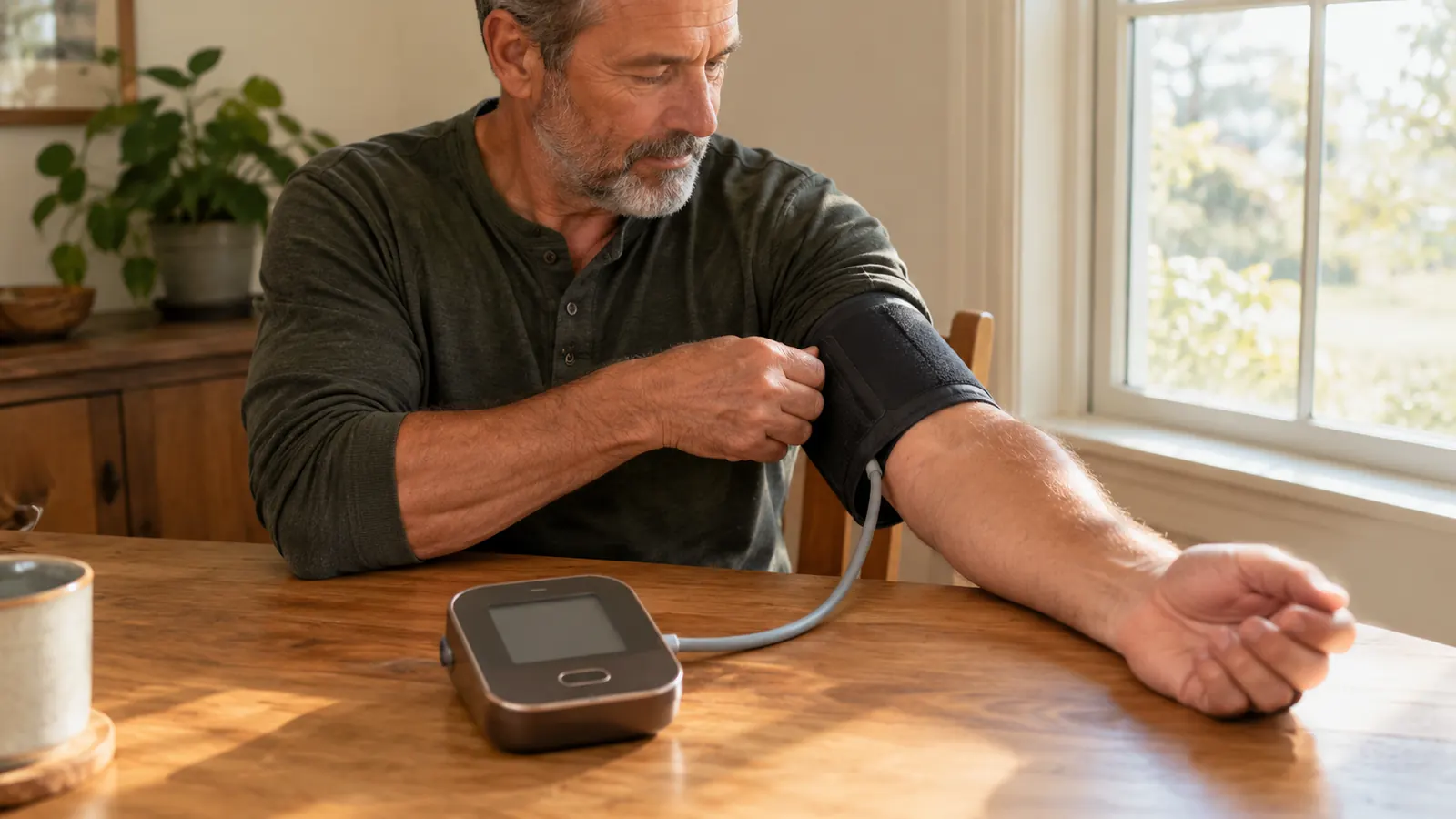
My routine has not changed much since the beginning. I sit in the same chair at the kitchen table, feet flat on the floor, arm resting on the table at heart level. I wait five quiet minutes first. Then I put on the cuff, press the start button, and sit still while it does its work. The whole thing takes about a minute, and the numbers appear on the LCD display.
The first week was the hardest. I was not used to sitting still for five quiet minutes, and I caught myself holding my breath or tensing my arm while the cuff tightened. My doctor had told me to sit with my feet flat and my arm resting on the table at heart level, but nobody warned me that I would have to teach my body to be quiet. By the second week I found a rhythm: I pour a glass of water, sit down in the same chair, and look out the window at the treeline while I wait. One morning I skipped the quiet minutes because I was running late, took a reading right after my coffee, and the number was noticeably higher than usual. I wrote it down anyway with a note that said 'after coffee, rushed.' That note is exactly the kind of thing my doctor likes to see, because it explains the reading instead of hiding it. The cuff itself took some getting used to. The first time I wrapped it around my arm, I put it on too loose and the monitor ran a second time before it settled on a reading. Now I pull it snug but not tight, and it works the first time.
I use the Omron Bronze most mornings. In the evenings I often use a different monitor, the Withings BPM Connect, because it syncs to my phone automatically. But the Bronze is the one I trust for my first reading of the day. It is the monitor my doctor's request built my habit around, and it has been dependable since the first week.
My husband Walt, who is 66, borrows the Bronze now and then. His arm fits the original cuff, but he found it fiddly to wrap by himself, so I bought the pre-formed Omron Large ComFit cuff, which fits arms 9 to 17 inches and works well on the Bronze. My own arm is about 11 inches, so I use the standard cuff that came in the box. The monitor stores up to 14 readings in its memory, which is enough for me because I also write everything down in a paper log.
What the Bronze Gets Right
The Omron Bronze is not a complicated machine, and that is its greatest strength. It is battery powered, runs on 4 AA batteries, and shows the reading on a clear LCD display. There is no phone required, no setup ceremony, no learning curve. You wrap the cuff, press start, and wait. For someone who needs to take two readings a day for months or years, that simplicity matters more than any extra feature.
Omron calls its approach Advanced Accuracy Technology, and I can only speak to my own experience: the readings have been consistent, and they have agreed closely with the readings I take on my other monitor. When I have brought my log to my doctor, the pattern my doctor sees in the numbers matches what I see at home. That is the whole point of home monitoring, and the Bronze delivers it.
The cuff is comfortable, which I did not expect. The standard cuff wraps around my upper arm without pinching, and the tube is long enough that I can position it without twisting. The included components are straightforward: cuff, pump, and tube. Nothing to assemble, nothing to figure out.
One morning last spring, I took a reading on the Bronze and then, two minutes later, took another on the Withings to compare. The systolic numbers were two apart and the diastolic numbers matched exactly. That kind of agreement is what I mean by consistent. I have done that comparison maybe a dozen times over the past year, and the two monitors have never disagreed by more than a few points. The display helps too. The LCD shows large, dark numbers that I can read without my glasses, which matters at 6:40 in the morning when I am not wearing them yet. The numbers stay on the screen long enough for me to find my pen and write them down, which is a small thing until you are trying to do it one-handed. And the batteries last a long time. I replaced the original 4 AA batteries after about nine months, and the monitor never gave me a false reading while they were fading; the display just got dimmer, which was my cue to swap them.
The Hypertension Indicator and What It Does
One feature I have come to appreciate is the Hypertension Indicator alert. When the monitor finishes a reading, it can show a symbol if the reading is elevated. I do not treat that symbol as a diagnosis. I treat it as a cue to sit quietly for a few minutes and take another reading later, and I always bring the full log to my doctor. But I like having the alert there because it keeps me honest about paying attention to the numbers.
I should be clear about what this feature does not do. It does not tell you what to do, and it does not replace your doctor. It is simply a flag on the display. For me, it has been a useful reminder to stay consistent with my habit, especially on mornings when I am tempted to skip the reading.
I remember one Tuesday morning in February when the alert showed up on the display for the first time in weeks. I had slept poorly, the kind of night where you are awake at 3:00 and never really get back to sleep. The reading was higher than my usual range, and the little indicator appeared next to the numbers. I did not panic. I wrote the reading in my log with a note about the bad night, finished my water, and sat for another five minutes before taking a second reading. The second one was closer to normal. When I brought that page to my doctor at my next appointment, she pointed at the note and said that was exactly the kind of information she wanted to see. The alert did not tell me anything I could not figure out from the numbers themselves, but it made me stop and pay attention. I have also learned not to read too much into a single alert. One high reading is a flag, not a verdict. The pattern across a week of readings is what my doctor cares about, and the alert is just a reminder to keep the pattern honest. It has never once made me anxious, because I know what it is and what it is not. It is a symbol on the display, not a message from my doctor.
What Annoyed Me Over Two Years
The memory is the biggest limitation. Fourteen readings is not very many. If you travel for a week and take two readings a day, you will fill the memory before you get home. I work around it by keeping a paper log, which I prefer anyway because I can write a short note next to each entry, like slept poorly or had coffee first. But if you want the monitor to be your complete record, the small memory will frustrate you.
The batteries also last a long time, which is good, but the monitor does not warn you much before the display starts to dim. I have learned to keep spare AA batteries in the kitchen drawer. And while the Omron connect app exists and this monitor can connect via Bluetooth, I rarely use it with the Bronze because my other monitor already syncs automatically. For someone who wants everything on their phone, the app is there and it stores unlimited readings. For me, the paper log is the record I trust.
One more small thing: the monitor is not heavy, about 1.2 pounds, and the dimensions are roughly 5.5 by 3.3 by 4.3 inches, so it does not take much space. But it is not something you slip into a pocket. It lives on the kitchen counter, and that is fine because that is where I do my readings.
I learned that the hard way on a trip to see my daughter in San Antonio last fall. I took the Bronze with me, which I do not usually do, because I wanted to keep my routine. Two readings a day filled the 14-reading memory by Thursday, and the monitor started overwriting the oldest readings. I had not brought my paper log, so I lost the first three days of the trip. That was my own fault, not the monitor's, but it taught me the rule I now follow: the Bronze is a tool for taking a reading, and the log is the record. The other thing I learned is that the Bluetooth sync is not something I can set and forget. When I do open the Omron connect app, I have to wait for it to find the monitor and then confirm that the reading made it across. It works, but it is an extra step, and on a busy morning it is easy to skip. That is why the paper log is still my main record and the app is the backup.
What I Liked
- Simple and consistent for twice-daily home readings
- Clear LCD display that is easy to read without glasses
- Comfortable 9 to 17 inch cuff that fits both my arm and Walt's
- Hypertension Indicator alert flags elevated readings
- Battery powered, so no cord or charging dock to manage
- Lightweight at about 1.2 pounds and compact on the counter
Where It Falls Short
- Memory holds only 14 readings, so a paper log or app is needed for long-term tracking
- No automatic sync unless you use the Omron connect app with Bluetooth
- Batteries eventually dim the display without much warning
- Not a travel monitor; it stays on the kitchen table
The Bronze does not do anything flashy. It just gives me a reading I trust, twice a day, and that trust is what kept the habit going for two years.

How It Compares to My Other Monitors
I own three monitors now, and I use each one for a different reason. The Omron Bronze is my morning monitor, the one I trust when I am half awake and just want the number. The Withings BPM Connect is my evening monitor, because it sends the reading to my phone automatically and builds the trend chart for me. And the Omron Gold wireless wrist monitor lives in my travel bag for trips to see my daughter in San Antonio, because it is easier to pack than an upper-arm model.
If I had to keep only one, it would be the Bronze. The wrist monitor is convenient but I trust upper-arm readings more, and the Withings requires the app to be useful. The Bronze does not need anything. It is the monitor I recommend to friends who ask, and it is the one I would buy again tomorrow.
Who This Is For
The Omron Bronze is for someone who wants a no-nonsense upper-arm monitor for daily readings at home. It is for the person who will actually use it, which means it is for the person who values simplicity over features. If your doctor has asked you to take readings twice a day and bring in a log, this monitor will do exactly that without getting in your way.
It is also for the person who shares a monitor with a spouse or partner. The 9 to 17 inch cuff fits a wide range of arm sizes, and the monitor stores up to 14 readings, so two people can take turns. Walt and I have shared the Bronze for months without any confusion about whose reading is whose, mostly because we write in the log right after we read the display.
Who Should Skip It
If you want your readings to sync to your phone automatically without thinking about it, skip the Bronze and get a monitor with built-in automatic sync, like the Withings BPM Connect. The Bronze can connect to the Omron connect app via Bluetooth, but it is not automatic in the same way, and you have to remember to open the app and sync.
If you travel constantly and need something small, skip the Bronze and get a wrist monitor. It will not replace an upper-arm monitor for daily use, but it is much easier to pack. And if you want a monitor that keeps a complete digital history on its own, the 14-reading memory will frustrate you. Buy a monitor with a larger memory or plan to use the app from day one.
The monitor that started my habit and still keeps it
Two years later, the Omron Bronze is still the first monitor I reach for. If you are ready to start your own daily readings, this is the one to try.
Amazon Check Today's Price on Amazon →