If you have ever been told to take your blood pressure at home and then tried to keep track of the numbers, you already know the problem: the reading is the easy part, and the log is where it falls apart. I bought the Withings BPM Connect about a year ago because I wanted the log to build itself while I sat at the kitchen table with my arm in the right position. It has changed my evening routine more than I expected, and I think it is worth a close look if you are in the same situation.
I want to be clear that I am not a doctor, and I am not going to tell you what your numbers mean. What I can tell you is what it is like to live with this cuff for a year, what surprised me, what annoyed me, and who I think should buy it. If that sounds useful, keep reading.
The Quick Verdict
The Withings BPM Connect is the monitor I reach for most evenings because it sends every reading to the Health Mate app without me writing it down. It is not a replacement for your doctor, and it will not lower anything on its own, but as a home log it is the easiest I have used.
Amazon Check Today's Price →If you are tired of copying readings into a notebook, this is the cuff to look at.
The Withings BPM Connect sends each reading to the Health Mate app over Wi-Fi or Bluetooth, so your log builds itself while you sit still for five quiet minutes. I still keep paper for my doctor, but the app is what makes the habit stick for me.
Amazon Check Today's Price on Amazon →How I've Used It
I am Ruth Pembrook, a retired school librarian in Round Rock, Texas. I am not a doctor or a nurse, and I want to be plain about that before I say anything else. About two and a half years ago, a routine checkup showed readings higher than my doctor liked, and she asked me to take readings at home twice a day for a few weeks and bring her a log. I have kept the habit since.
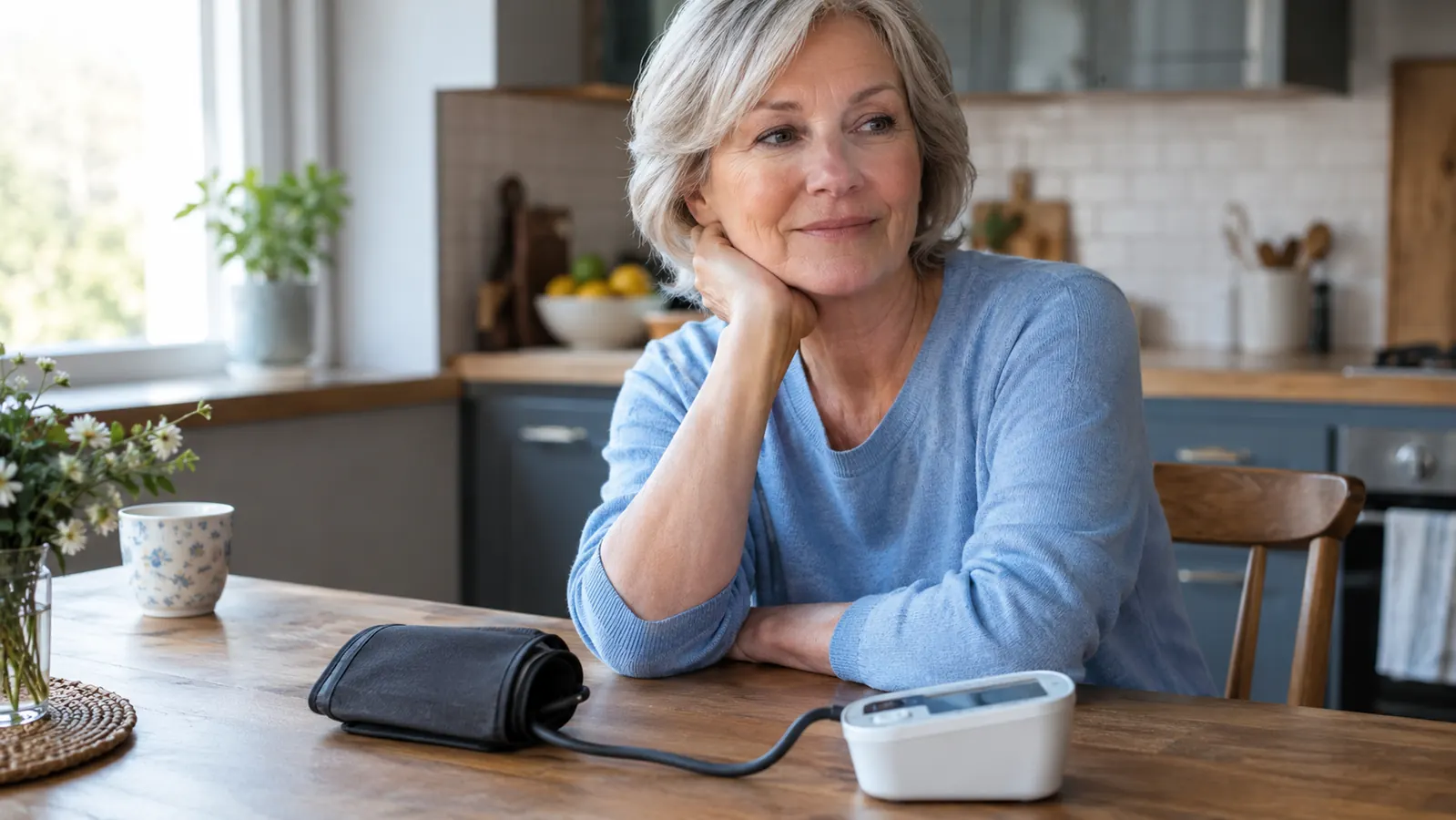
My usual setup is simple. I read at the kitchen table, sitting in the same chair, feet flat, arm resting on the table at heart level, after five quiet minutes. For about two years, my daily monitor was an OMRON Bronze upper-arm cuff, and I still use it most mornings. The Withings BPM Connect is the one I reach for most evenings, and sometimes I take one reading on each to compare.
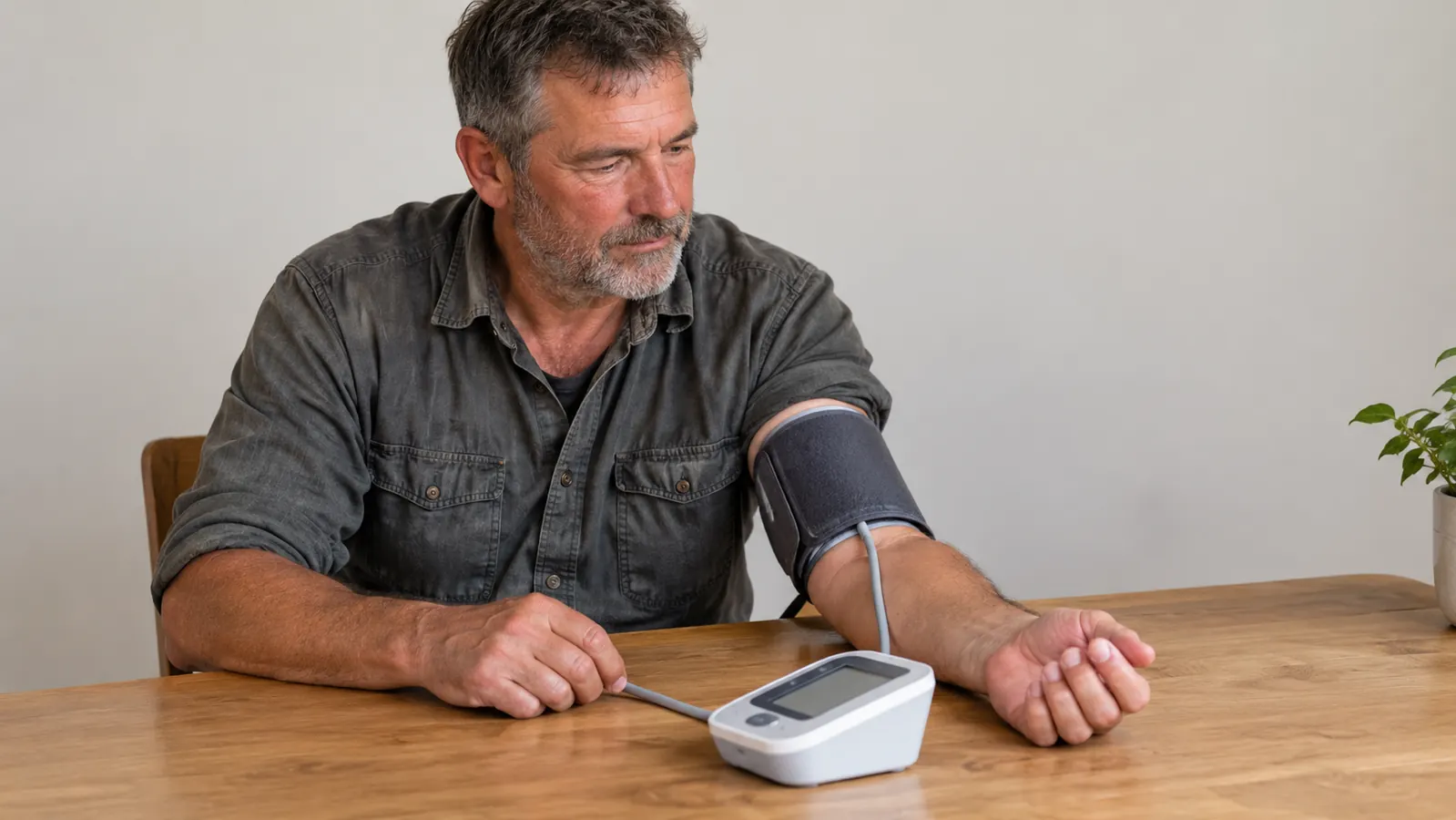
Walt, my husband, is 66 and the only other person in the house. His upper arm measures about 15 and a half inches, and the Withings cuff fits a range of 22 to 42 centimeters, so it works for both of us. I keep a paper log in the kitchen drawer because that is what I bring to appointments, and I also use the Withings app. The two logs serve different purposes, and that is part of what I want to talk about.
I take my morning reading on the OMRON Bronze because it is the monitor my routine started with, and I take my evening reading on the Withings. That sounds fussy, but it is not. The two cuffs sit in the same drawer, and I reach for whichever one fits the moment. When I want the reading to appear in the app without any effort, I choose the Withings.
One Tuesday evening in March, I took my reading, set the cuff back in the drawer, and got pulled into a phone call. At bedtime I realized I had not written the numbers in the paper log. I opened the app, and there it was, dated and timed. That was the night I stopped worrying about whether the habit would hold.
Why I Added It to My Kitchen Table Routine
The honest reason I bought the Withings BPM Connect was the log. I had been writing readings on paper for over a year, and I was good about it, but I could see the day coming when I would skip a night and tell myself I would catch up later. The Withings cuff is FDA cleared, it is an upper arm monitor, and it syncs to the Health Mate app over Wi-Fi and Bluetooth. That means the reading appears in the app without me doing anything except taking the reading.
The display is an LCD, and the cuff gives color-coded feedback on the display case, which I appreciate at the end of a long day. I do not have to squint at a tiny screen or try to remember what the numbers meant. The cuff is battery powered and the charger is included, so I do not have cords running across the kitchen counter. It weighs 12.8 ounces, which is light enough to sit on the table without me thinking about it.
I will be honest that I did not expect the sync to feel like a big deal. I had been writing readings down for a long time, and I was not looking for another device to manage. But the first evening I used the Withings, I took the reading, put the cuff back in the drawer, and later saw it in the app. That was the moment I understood why people like this monitor.
The spiral notebook I used before had a torn page and a coffee ring on the cover, and one week in February I missed three nights in a row and told myself I would fill them in from memory. I could not, and that is the failure that made me look for a monitor that keeps the log for me.
The Upper-Arm Cuff and the Numbers It Gives Me
I have used wrist monitors, and I still keep an OMRON Gold wireless wrist monitor in my travel bag for trips to see my daughter in San Antonio. At home, I prefer an upper arm cuff. The Withings BPM Connect is an upper arm monitor with a band that fits 22 to 42 centimeters, and that range covers my arm at about 11 inches and Walt's at about 15 and a half. The cuff has a stainless steel finish, and the whole unit is 6.1 inches long, 2.36 inches wide, and 2.16 inches thick, so it takes up very little drawer space.
I want to be careful here. A monitor measures, and it does not treat or lower anything. I have never assumed that using the Withings cuff changed my numbers. What it changed was how reliably I took readings and how easy it was to show my doctor a complete log. When I take one reading on the Withings and one on the OMRON Bronze, the numbers are usually close, but they are not always identical, and I do not panic about that. I bring both logs to my doctor and let her interpret them.
One evening in June, I took a reading on the Withings, set it aside, and took a second reading on the Bronze a minute later. The top numbers were four points apart, and the bottom numbers matched. I did not decide anything from that. I wrote both in the log, and I let my doctor look at the pattern.
I also appreciate that the cuff is not tucked away in a case that I have to fight with. The dimensions are printed on the box, but what matters at 7 in the evening is that it sits flat on the table, that the band wraps around my arm without pinching, and that the display is easy to read. The LCD is clear, and the color-coded feedback on the display case gives me a quick sense of where the reading falls without me having to interpret anything myself.
What I Wish I'd Known Before Buying
The first thing I wish someone had told me is that the app does not replace the paper log unless you want it to. My doctor is happy to see the app, but I still fill in my paper log because that is the habit I built. The Withings app is good, and it is useful to see the readings line up over time, but it wants to be the center of your health data, and that took me a little while to get used to.
The second thing is that cuff placement matters more with this monitor than with a simpler one. You still have to sit the way you always should: feet flat, arm supported, cuff at heart level, quiet for a few minutes. The Withings does not do the sitting for you. I also learned to be patient with the charger. Because it is battery powered, I keep the charger in the same drawer as the cuff, and I plug it in when the battery gets low. The two year manufacturer warranty is a comfort, but I have not needed it.
The first few weeks, I let the band sit a little loose because the standard cuff on my other monitor had always been snug. A loose band gave me evening readings that did not match the morning ones, and I could not figure out why. Once I pulled the Withings band snug, so it stayed in place without pinching, the evening readings settled down and matched the mornings more closely.
There is also the question of who else will use it. Walt uses the Withings sometimes, and the band fits him because it goes up to 42 centimeters. If you live alone and your arm is smaller, the same cuff still works, but you may not need the wide range. I would not buy this monitor for the band range alone. I would buy it for the log.

What the Health Mate App Does for Me
The Health Mate app is the reason this cuff exists for me. When I finish a reading, the cuff sends it to the app over Wi-Fi or Bluetooth, and I can open the app later and see the date, the time, and both numbers. I do not have to remember to write it down in the moment, and I do not have to trust my memory at the end of the week.
I still keep a paper log because that is what I bring to my appointments, but I have stopped worrying about whether I will remember a reading. The app gives me a second copy without me asking for it. When I sit down with my doctor, I have the paper log in my hand and the app on my phone, and she can look at whichever she prefers.
I do not use the app as a place to make decisions about my health. I use it as a log. That keeps things simple. If you are the kind of person who likes to see the readings line up over time, you will probably enjoy the app. Just remember that the monitor is doing the measuring, and your doctor is doing the interpreting. On mornings when I take the Bronze reading first, I open the app later to check that the evening reading from the night before is there waiting for me.
What I Liked
- Wi-Fi and Bluetooth sync to the Health Mate app, so readings land in the log automatically
- FDA cleared upper arm monitor
- Color-coded feedback on the display makes the reading easy to interpret at a glance
- Fits arms 22 to 42 centimeters, which covers my arm and Walt's
- Battery powered with a charger included, so no cord clutter
Where It Falls Short
- I still keep a paper log for my doctor, so the app does not fully replace my notebook
- It is bulkier than a wrist monitor, so I keep the OMRON Gold in my travel bag instead
- The app wants to be the center of your health data, which took me a little getting used to
- The cuff needs to be positioned carefully; it is not a press-one-button-and-go device
I have used this cuff most evenings for about a year, and the app log has never lost a reading.
Who This Is For
This monitor is for anyone who has been told to take readings at home and who knows that the hard part is not the cuff, it is the consistency. If you want a log that builds itself in the Health Mate app, if you want an FDA cleared upper arm monitor, and if you are willing to sit still for five quiet minutes twice a day, the Withings BPM Connect is a strong fit. It also works well in a house with two people because the 22 to 42 centimeter band fits a wide range of arms.
It is also a good fit if you are the person in the house who keeps the appointments and the records. I am that person. I like that the Withings gives me a clean second copy of every reading, and I like that I can bring something complete to my doctor without making a project out of it.
Who Should Skip It
If you want a monitor that you can use while you are moving around, or if you only check your blood pressure a few times a month, this is probably more than you need. The app and the Wi-Fi sync only matter if you are going to use them. If you prefer a wrist monitor for travel, I would keep that for the road and use an upper arm cuff at home. And if you are not ready to bring a log to your doctor, no monitor will do that part for you.
Skip it if you are looking for a monitor to take on a plane or to the office. The Withings is an upper arm cuff, and while it is not heavy at 12.8 ounces, it is not something I would keep in a purse. I have the OMRON Gold wrist monitor for travel, and that division works well for me.
Start with a cuff that makes the log easy, and bring that log to your doctor.
The Withings BPM Connect is the one I reach for most evenings. It is FDA cleared, it fits my upper arm, and it puts every reading in the app without me writing it down. See today's price on Amazon and decide if it fits your routine.
Amazon Check Today's Price on Amazon →