

Nobody tells you this about wrist blood pressure monitors: they are not a compromise you make because you are lazy. They are a trade you make because your life is somewhere else. Mine is in a travel bag. I am Ruth, I am 63, and I have been taking my blood pressure at home for about two and a half years, ever since a routine checkup produced numbers my doctor wanted to see more of. My daily monitor is an Omron upper-arm unit that sits in its usual spot on the kitchen table. The Omron Gold Wireless Wrist Blood Pressure Monitor lives in my travel bag for trips to see my daughter in San Antonio. This is the honest review of the Omron Gold I wish someone had given me before I bought it: the convenience is real, the portability is wonderful, and the trade-offs are specific and manageable if you know them.
Let me be clear about what I am and am not. I am not a doctor or a nurse. I am a retired middle-school librarian who got told to take readings at home twice a day and bring a log, and I have kept the habit ever since. A monitor measures. It does not treat, it does not lower anything, and your doctor is the one who interprets your numbers and decides on treatment. What I can give you is a year of honest notes from using the Omron Gold on the road, in hotel rooms, at my daughter's kitchen table, and in my own living room when I wanted to compare it against my upper-arm unit.
The Quick Verdict
The Omron Gold is the most convenient blood pressure monitor I own, and the one I trust least if I am careless about position. Buy it for portability and the 200-reading memory. Know that wrist placement matters more than the monitor's accuracy.
Amazon Check Today's Price →Need a monitor that fits in a travel bag?
The Omron Gold Wireless Wrist Blood Pressure Monitor stores 200 readings per user, pairs with the free Omron Connect app, and has traveled with me for a year without a single leak or misfire. Check today's price on Amazon and see if it fits your routine.
Amazon Check Today's Price on Amazon →How I've Used It
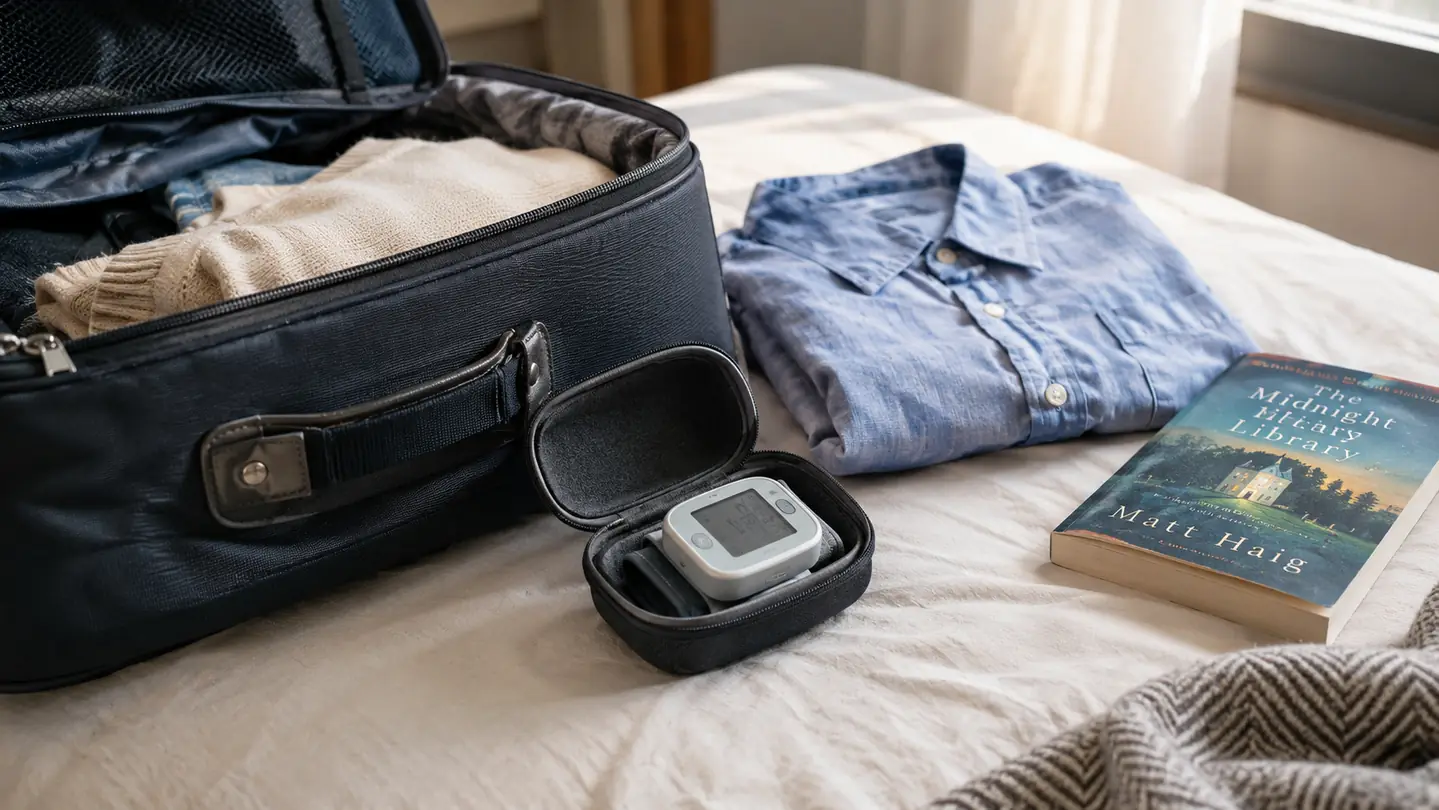
I bought the Omron Gold about a year ago, mostly because I was tired of forgetting my readings when I traveled. My doctor wanted a log, and a log with three missing days because I left the monitor at home is not much of a log. The Gold is small. The product dimensions are 3.58 by 0.52 by 2.49 inches and it weighs 3.2 ounces, which means it disappears into the side pocket of my travel bag next to a book and a folded shirt. It comes with a case, it runs on two AAA batteries that are included, and it stores up to 200 readings each for two users. That two-user memory is what sold me, because Walt, my husband, sometimes borrows a monitor when he wants to check his own numbers, and I did not want my log mixed with his.
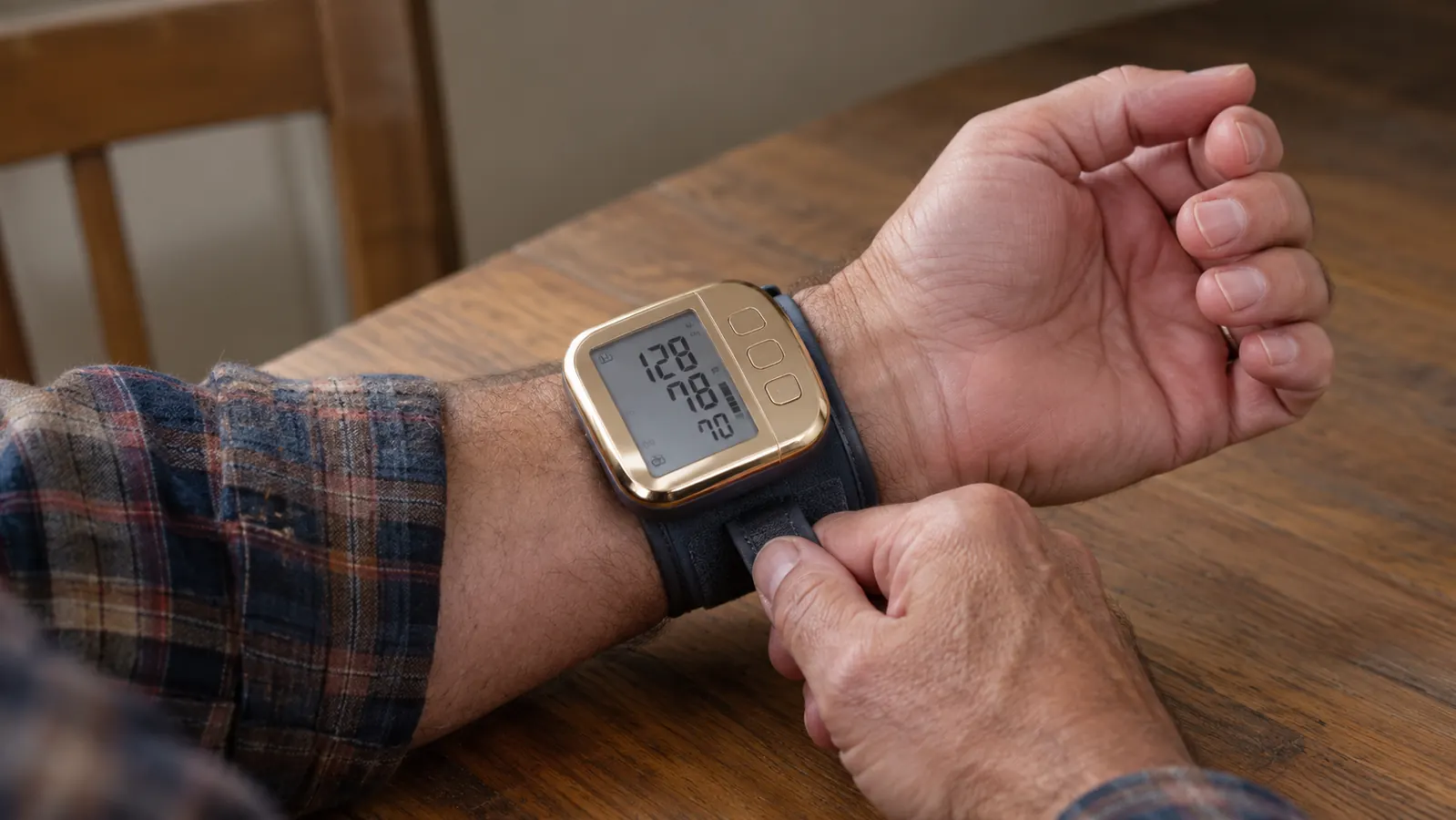
Here is the routine that works for me. I sit at whatever table is available, feet flat, back against the chair, and I rest my forearm on the table so the monitor sits at heart level. I sit for five quiet minutes first, no coffee, no phone, no conversation. Then I take the reading, write the date, time, both numbers, pulse and a short note in my paper log, and go on with my day. The Omron Gold makes this easy because the band is 8.5 inches and it wraps around my wrist with room to spare. It is not a fiddly device. It is a small, patient, well-designed one.
The Omron Gold comes in a small box with the monitor, a case, and two AAA batteries included. The case is the detail I did not expect to care about. It is slim and zips shut, and it keeps the monitor from rattling around in my bag. The monitor itself is light enough that I sometimes forget it is in the side pocket, which is exactly what I want from a travel monitor. The band is 8.5 inches, and the whole unit is 3.58 by 0.52 by 2.49 inches. That thin profile means it does not bulge out of a pocket or a purse. It feels sturdy without feeling heavy. After a year of trips, the case has a few scuffs and the monitor still looks and works like the day I bought it.
What Nobody Tells You: Position Is Everything
Here is the honest part. A wrist monitor measures the artery in your wrist, not your upper arm, and that means the height of your wrist relative to your heart matters a great deal. If my wrist drops below heart level, the reading runs higher. If I prop it too high, it runs lower. The monitor is not wrong. I am wrong, and the monitor is faithfully reporting what it sees at the wrong height. The Omron Gold does exactly what it is supposed to do. It is my job to put it in the right place, and that is the part nobody tells you about in the product listing.
The other thing nobody tells you: wrist monitors are more sensitive to movement than upper-arm monitors. I learned this in a hotel room in San Antonio when I took a reading, got an odd number, frowned, and realized I had been wiggling my fingers without noticing. I sat still, took a second reading, and the number was completely ordinary. The monitor was fine. I was the variable. Once I understood that, I stopped blaming the device and started being more careful about sitting still for the whole cycle.
The High Morning Average Indicator, and Why I Use It
One feature of the Omron Gold that I have come to appreciate is the High Morning Average Indicator. Morning spikes in blood pressure are linked to higher cardiovascular risk, and the monitor tracks your morning readings and flags when the average runs high. I am not a doctor, so I do not interpret what that means for me personally. What I can tell you is that it made me notice a pattern in my own log: my morning readings ran higher than my evening readings more often than I expected. I printed that pattern out, brought it to my doctor, and let my doctor tell me what it meant. That is the correct division of labor, and I wish more people understood it.
The indicator is not a diagnosis. It is a flag. It says, look at this, maybe mention it at your next appointment. That is exactly what I did, and it turned a vague feeling that my mornings were off into a concrete conversation with my doctor. For that alone, the Gold earns its place in my travel bag.
The App and the Two-User Memory: Convenient, With Caveats
The Omron Gold connects to the free Omron Connect app via Bluetooth, which means I can store unlimited readings, track trends, and see my numbers on my phone instead of squinting at a paper log. I use the app when I travel because it is one less thing to lose. The caveat is that I still keep my paper log, because my doctor likes seeing the written page, and because a paper log does not run out of battery. The app is a convenience, not a replacement for the habit.
I will also tell you honestly that Bluetooth pairing is not the magical experience the box implies. It took me a few tries the first time, and I have learned to open the app before I take the reading so the sync happens smoothly. Once it pairs, it is reliable. It is just not instant, and anyone who tells you otherwise is selling you a story.
The Omron Gold stores up to 200 readings each for two users. That might sound like a minor detail until you share a monitor. Walt and I have different habits, different schedules, and different reasons for checking. When we traveled together, we could both use the Gold and keep our readings separate. No confusion, no accidental mixing of logs. For a couple, that is a genuinely useful feature.
I also like that the 200-reading memory means I do not have to sync the app every single time. If I am on a short trip and forget to open the app, the readings wait for me. When I get home, I can open the Omron Connect app and catch up. That is the kind of thoughtfulness that makes a device feel designed for real people.
Battery Life and Everyday Annoyances
The Gold runs on two AAA batteries that are included in the box. I have replaced them twice in a year, which seems reasonable for a device I use a few times a week on trips. The monitor does not have a charging cable to lose, and it does not need to be plugged in, which is another point in its favor for travel.
The honest annoyance is the pairing. Bluetooth is convenient when it works, and it usually does, but the first time I tried to connect the Gold to the Omron Connect app, I had to fiddle with it longer than I expected. I have learned to open the app first, then take the reading, and the sync goes smoothly. It is a small quirk, not a dealbreaker, but I would rather tell you about it now than have you discover it in a hotel room.
How It Compares to My Upper-Arm Monitor at Home
My daily monitor at home is an Omron upper-arm unit, and I have taken side-by-side readings with the Gold more than once. The numbers are close. Not identical, because no two readings are identical, but close enough that I trust the Gold for travel and the upper-arm unit for my daily kitchen-table habit. The upper-arm unit is easier to position correctly because the cuff sits on my upper arm and the angle is more forgiving. The Gold is easier to pack. That is the trade in one sentence.
For Walt, whose upper arm measures about 15 and a half inches and who uses the Omron Large ComFit cuff on our upper-arm monitor at home, the Gold's wrist band is not a replacement. The band is 8.5 inches, and while it fits my wrist easily, Walt prefers the upper-arm cuff. That is fine. The Gold was never meant to be the only monitor in the house. It was meant to be the one that goes with you.
What I Liked
- Extremely portable: 3.2 ounces and small enough for a travel bag pocket
- Stores 200 readings each for two users, so a partner can share it
- High Morning Average Indicator flags a pattern worth mentioning to your doctor
- Pairs with the free Omron Connect app via Bluetooth for unlimited storage
- Comes with a case and two AAA batteries included
Where It Falls Short
- Wrist position matters more than with an upper-arm monitor, so careless placement gives less trustworthy readings
- More sensitive to movement during a reading
- Bluetooth pairing took a few tries at first
- Band is 8.5 inches, so it will not fit every wrist comfortably
The Omron Gold is not a less accurate monitor. It is a more demanding one. Give it five quiet minutes and a wrist at heart level, and it rewards you with a reading you can actually bring to your doctor.
How I Pack It and Use It on the Road
My routine for a trip to San Antonio is simple. The Gold goes in the side pocket of my travel bag, inside its case, next to my paper log and a pen. When I arrive, I set it on the nightstand or the kitchen table, depending on where I am staying. In the morning, after my coffee but before I get busy, I sit down, take my five quiet minutes, and take a reading. It takes less time than brushing my teeth.
The portability has genuinely changed how consistent I am. When I only had an upper-arm monitor, I sometimes skipped readings on trips because packing it felt like a production. The Gold removes that excuse. It is small enough to forget you are carrying it and simple enough that you never dread using it. Consistency is the whole point of home monitoring, and the Gold makes consistency easy.
What I'd Tell a Friend
If a friend asked me whether to buy the Omron Gold, I would say yes, with two conditions. First, understand that wrist placement matters. Read the manual, sit still, keep your wrist at heart level, and you will get readings you can trust. Second, remember that the monitor is a tool, not a treatment. Bring your log to your doctor and let your doctor do the interpreting.
I would also tell my friend to think about where the monitor will live. If it will sit on a nightstand and never move, an upper-arm monitor might be a better fit. If it will travel, live in a drawer, or serve two people, the Gold is hard to beat. It is not the monitor I use most at home. It is the monitor I trust most when I am away from home.
Who This Is For
The Omron Gold is for you if you travel, if you have a partner who also wants to track readings, or if you simply want a monitor that lives in a drawer and comes out without a production. It is for people who will sit still for five minutes and place their wrist at heart level. It is for people who understand that a monitor is a tool, not a treatment. If that is you, the Gold is a very good tool.
Who Should Skip It
Skip the Omron Gold if you already struggle to keep your arm still during a reading, if you have mobility issues that make it hard to hold your wrist at heart level, or if you want a monitor you can use without thinking about position at all. An upper-arm monitor is more forgiving. Also skip it if you have no interest in an app and no need for 200 readings of memory, because you would be paying for conveniences you will not use. There is no shame in that. Buy the tool that fits your actual life.
Ready to make travel readings easier?
After a year of trips to San Antonio, the Omron Gold Wireless Wrist Blood Pressure Monitor is still the first thing I pack. Check today's price on Amazon and decide if the trade-offs are worth it for your routine.
Amazon Check Today's Price on Amazon →