
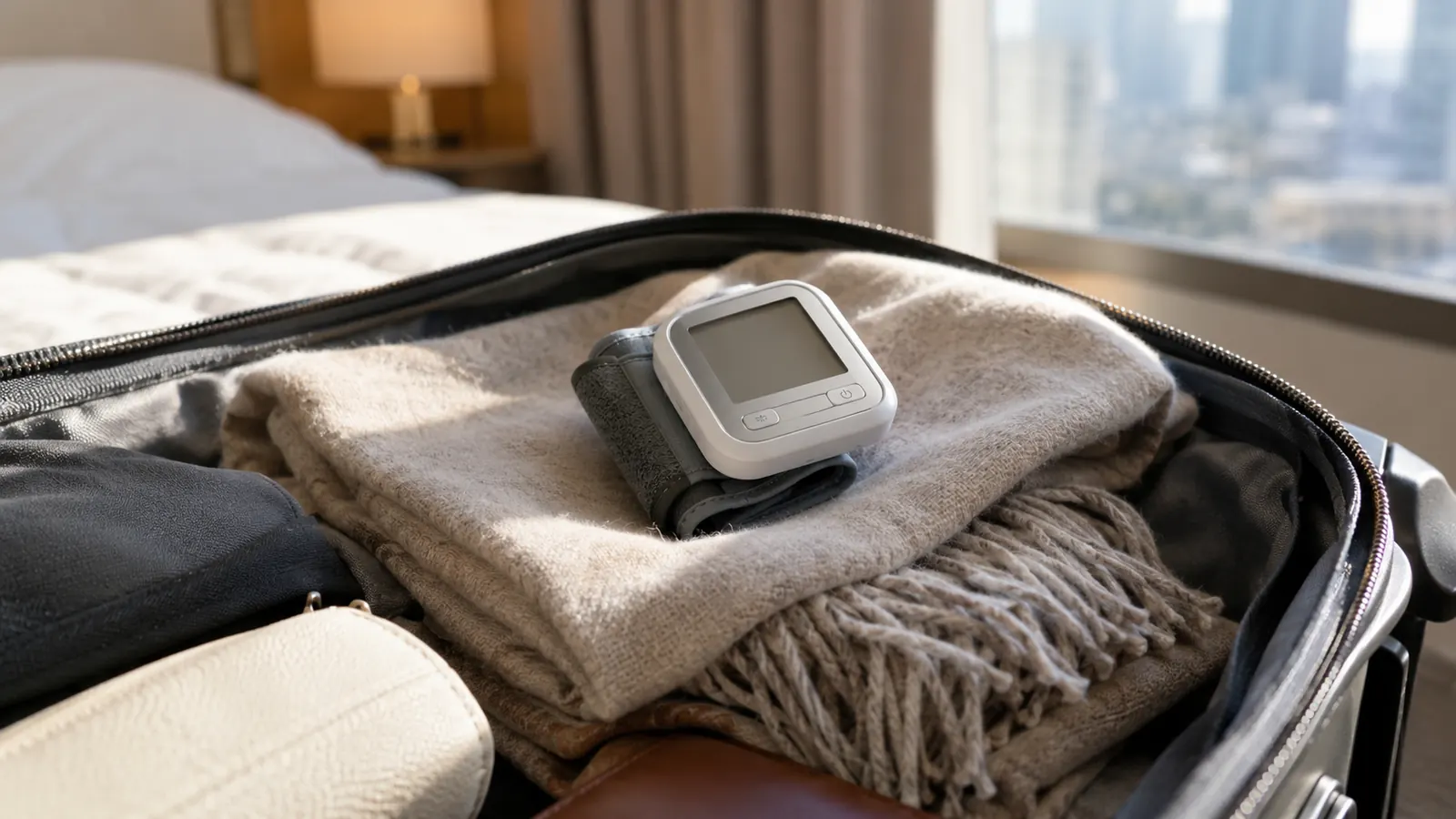
I have kept a blood pressure log for about two and a half years now, ever since my doctor asked me to take readings at home twice a day and bring in a notebook. Most of that time I have used an upper-arm monitor at my kitchen table, and it sits there still. But when my daughter moved to San Antonio and I started making the drive a few times a year, I wanted something that could go with me without filling half my suitcase. That is why the Omron Gold wrist monitor ended up in my travel bag, and why I am writing this review about a year after I started using it.
If you are thinking about a wrist monitor for trips, or for mornings when you want a reading without pulling out the bigger unit, I want to give you the plain-spoken version. I am not a nurse and I am not a doctor. I am a retired librarian who takes her blood pressure twice a day, keeps a paper log, and has strong opinions about what is easy and what is fiddly. Here is what a year with the Omron Gold has actually been like.
The Quick Verdict
A genuinely pocket-size Omron wrist monitor that is easy to pack and simple to use, with a few quirks you should know about before you buy.
Amazon Check Today's Price →The wrist monitor that lives in my travel bag
After a year of trips to San Antonio and back, the Omron Gold is the monitor I reach for when I am packing. It stores readings for two people, pairs with the free Omron app, and fits in a jacket pocket. Check today's price before you decide.
Amazon Check Today's Price on Amazon →How I've Used It
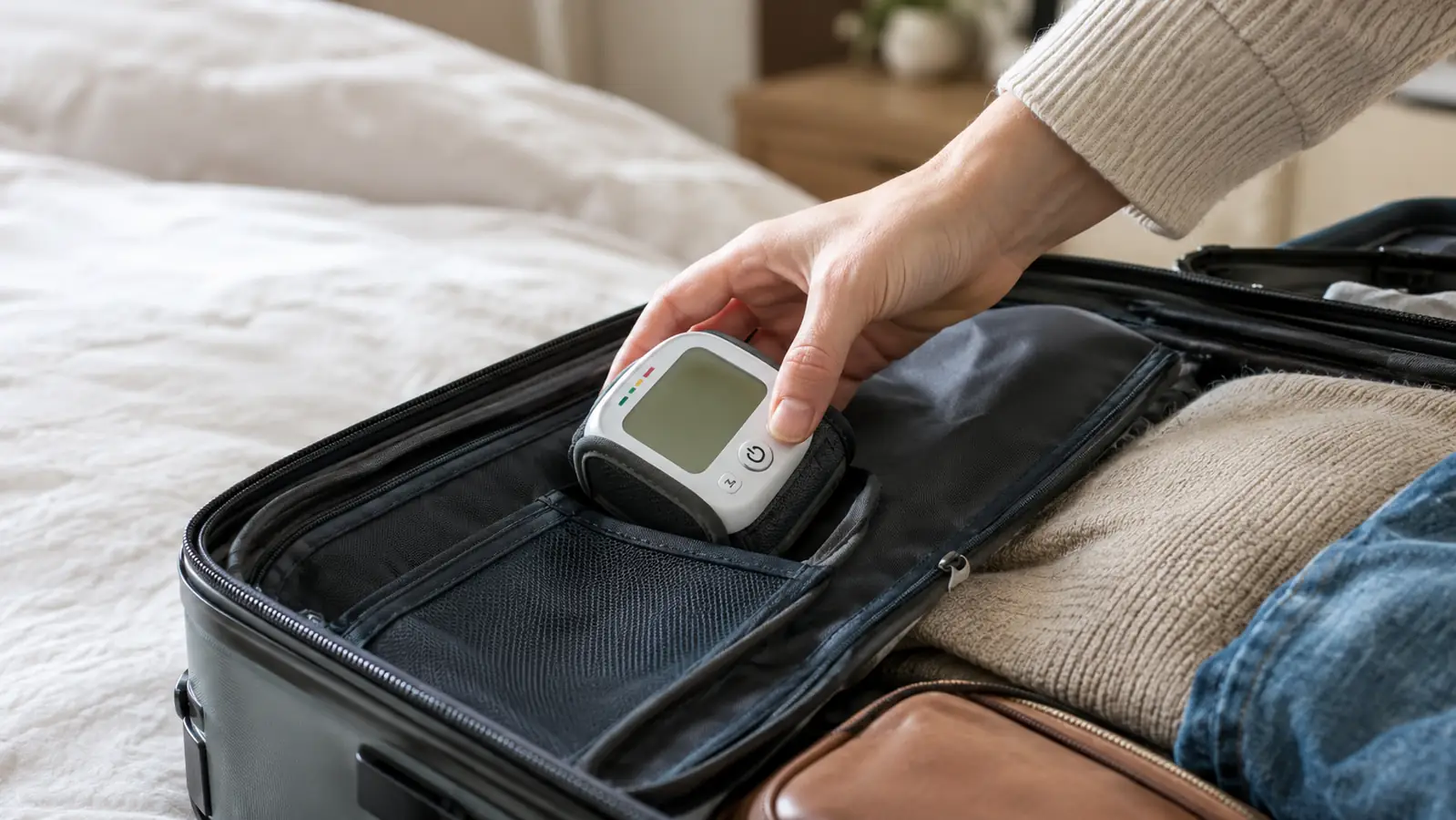
The Omron Gold lives in my travel bag, and that is where it has stayed for about a year. When I am home in Round Rock, I still take my morning reading with my upper-arm monitor at the kitchen table, sitting in the same chair, feet flat, arm resting on the table at heart level, after five quiet minutes. The wrist monitor is the one I pack when I drive to San Antonio to see my daughter, because it is small enough to tuck into the front pocket of my suitcase.
In practice, I have used it in a hotel room at a desk, at my daughter's kitchen table, and once on a weekend trip when I forgot my usual monitor entirely. The routine is the same as at home: five quiet minutes, sit down, rest my wrist at heart level, and take the reading. The monitor is battery powered and takes two AAA batteries, which were included in the box, so I have never had to hunt for a battery on a trip.
The band is listed at 8.5 inches, and it fit my wrist without any trouble. My husband Walt, whose upper arm measures about 15 and a half inches, tried it once when the upper-arm monitor was in the other room. The Omron Gold stores up to 200 readings each for two people, which matters more than I expected. It means two people could share it on a trip without mixing up their numbers.
The first time I packed it, I will admit I was skeptical. Years before my doctor asked me to keep a log, I had owned a hand-me-down wrist unit of unknown age, and I had stopped trusting it because the numbers seemed to bounce around depending on how I held my arm. So on that first trip to San Antonio, I did something a little excessive: I packed the Omron Gold and my upper-arm monitor both. Every morning for three days I sat at my daughter's kitchen table, took a reading with one, waited a few minutes, and took a reading with the other. The numbers were not identical, but they were close enough that I stopped worrying by the second morning. That trip is the reason the wrist monitor has stayed in my travel bag ever since, and it is the same reason I tell friends to try a new monitor against the one they trust before they rely on it.
What the Omron Gold Does Well
The first thing you notice is the size. The product dimensions are 3.58 x 0.52 x 2.49 inches, and the item weight is 3.2 ounces. That is not a marketing exaggeration. It is genuinely small enough to drop into a jacket pocket or the small front pocket of a suitcase, and I have done both. For someone who travels a few times a year and does not want to pack a full upper-arm unit, that alone is a good reason to look at it.
The second thing is the memory. It stores up to 200 readings for you and another 200 for a partner, which is a lot more than my old hand-me-down wrist unit ever did. When I come home from a trip, I can open the included case, take the monitor out, and still find the reading from Tuesday morning. That is the kind of detail that matters when you are trying to keep a consistent log for your doctor.
The included case deserves its own mention. It is not a hard shell, just a soft pouch with a zipper, but it is exactly the right size for the monitor and it keeps the screen from getting scratched against the other things in my bag. I keep the monitor in the case with the two AAA batteries inside, and when I unpack at my daughter's place, I set the whole case on the nightstand so I do not have to hunt for it at 6:40 in the morning. The memory feature became real to me on the second trip. I took my reading, set the monitor down, and my daughter asked me a question right as the screen went dark. I could not remember the second number. With my old hand-me-down unit, that reading would have been gone forever. With the Omron Gold, I could bring that reading back up on the screen, along with the readings from the previous two mornings. That is the kind of moment that makes a feature you read about on a spec sheet actually matter.
The third thing is the app. The Omron Gold connects to the free OMRON connect app via Bluetooth, so I can store unlimited readings, track trends, and see my history on my phone. It uses the same OMRON Connect app as my Bronze, so at least that part did not mean learning anything new. But for trips, the Omron app has been reliable, and the Bluetooth connection has never given me trouble. It is a nice way to keep a trip's readings in the same place as the rest of my log.
After a year of trips, the Omron Gold is the monitor I pack without thinking. It is small, it remembers two people's readings, and it has never once failed to turn on.
Where the Omron Gold Gets Tricky
Now the honest part. A wrist monitor is not the same as an upper-arm monitor, and I would be doing you a disservice if I pretended otherwise. The reading depends on where you hold your wrist. If my wrist is not at heart level, the numbers come out different. I learned to rest my arm on the table, the same way I do with my upper-arm monitor, and that helps a lot. But it is still easier to get a consistent reading with the upper-arm unit at my kitchen table.
The band is also worth a moment. At 8.5 inches, it fit me fine, but if you have a larger wrist, you should measure before you buy. Walt could wear it, though he still prefers his upper-arm cuff. If your wrist is much bigger than average, this may not be the monitor for you, and an upper-arm unit with a larger cuff would be a better fit.
The other quirk is the morning average indicator. The Omron Gold has a High Morning Average Indicator that checks for morning blood pressure spikes linked to higher cardiovascular risk. That is a useful feature, but it only works if you take your readings consistently in the morning. When I travel, my mornings are not always at the same time, so the indicator is less useful on the road than it is at home. It is not a problem, just something to know.
The morning average indicator is the feature I have the most complicated feelings about. At home, my morning reading happens at about 7:15, after I have poured my first cup of coffee and before I sit down to drink it, and the indicator is meant to flag mornings when that reading runs higher than my usual range. I can see why my doctor would want to know about that. But on a trip, my mornings follow my daughter's schedule, not mine. One weekend we planned to go to the market at nine, so I took my reading at 6:40 before we left. The next morning I slept until eight. The indicator flagged one of those readings, and I had to sit and think about whether it was a real spike or just a different time of day. At home, where my timing is steady, that feature would be more useful. On the road, I take it with a grain of salt.
How It Compares to My Upper-Arm Monitor
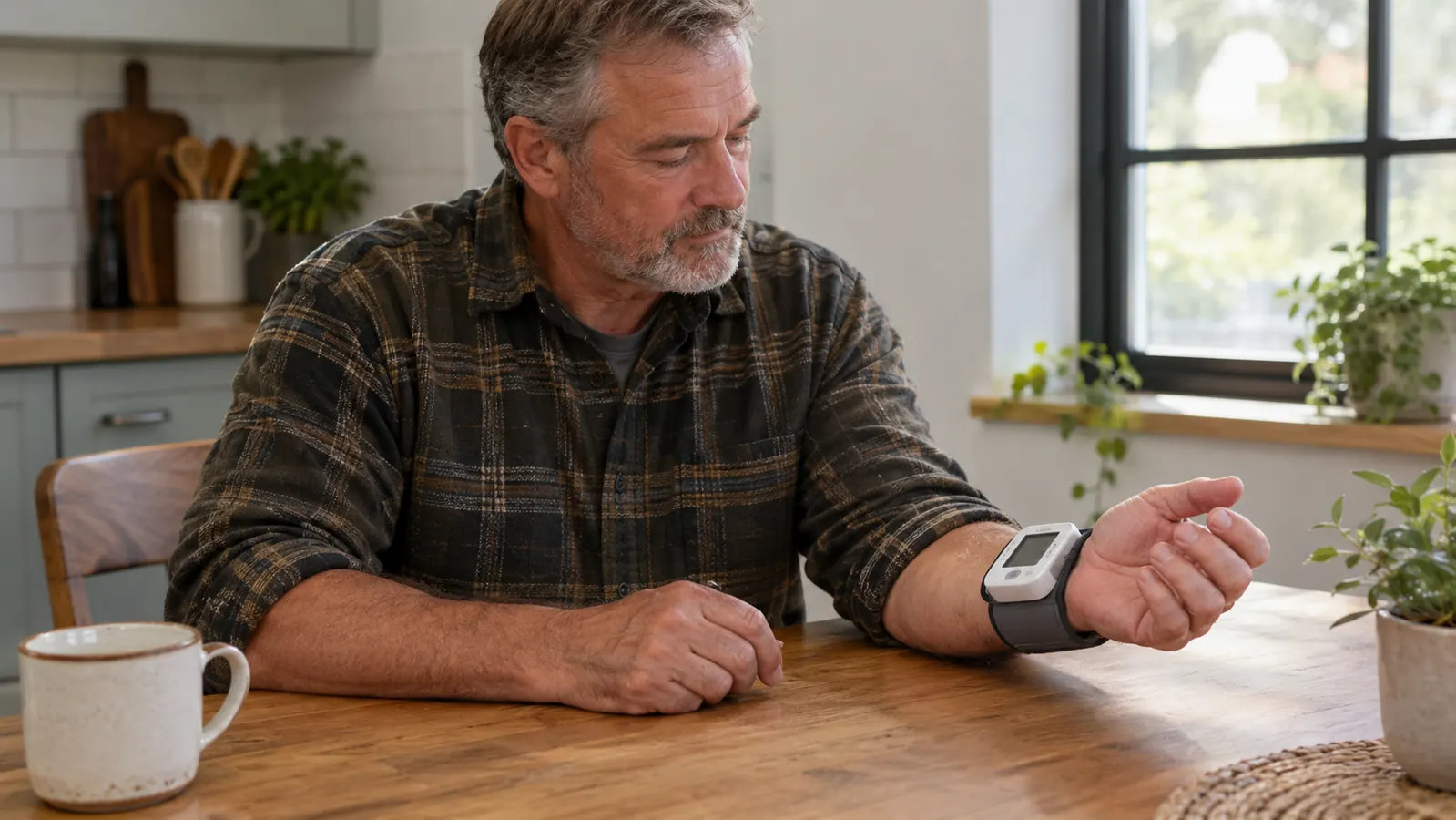
I have used an Omron upper-arm monitor at my kitchen table for about two years, and I am not going to tell you the wrist monitor replaces it. At home, I still reach for the upper-arm unit. It is easier to position, the cuff fits my arm at about 11 inches, and I trust the consistency of the readings more. The wrist monitor is for travel, and for the occasional evening when I want a quick reading without pulling out the bigger unit.
What surprised me is how often the wrist monitor has been the right tool anyway. When I am at my daughter's place in San Antonio, I do not want to pack an upper-arm unit and a cuff. I want something that fits in the front pocket of my suitcase and does not make me think. The Omron Gold does that. It is not my daily monitor, but it is the monitor that goes with me.
One evening last fall I did the kind of comparison I wish I had read before I bought anything. I took my evening reading with the upper-arm monitor at the kitchen table, waited five quiet minutes, and took another reading with the Omron Gold, same chair, same arm, same posture. The systolic numbers were seven apart, which my doctor had told me was within the normal range of variation between two different monitors. I repeated it the next morning and got numbers four apart. That is close enough for me to trust the wrist monitor on trips, and it is why I write in my log which monitor I used for each reading. My doctor reads that log, and I want her to know exactly what she is looking at. If the numbers had been wildly different, I would have left the wrist monitor at home and gone back to packing the upper-arm unit, case and all.
If you are trying to decide between a wrist monitor and an upper-arm monitor, I would say this: if you travel even a few times a year, the wrist monitor is worth having. If you are only going to own one monitor and you want the most consistent readings, an upper-arm unit is probably the better choice. I own both, and I use both, just for different reasons.
What I Liked
- Genuinely pocket-size at 3.58 x 0.52 x 2.49 inches and 3.2 ounces
- Stores up to 200 readings each for two people
- Connects to the free OMRON connect app via Bluetooth
- Battery powered with two AAA batteries included
- Includes a case, so it is easy to pack
Where It Falls Short
- Wrist position matters a lot for consistent readings
- Band is 8.5 inches, so it may be snug on larger wrists
- Morning average indicator only works with consistent morning readings
- Not a replacement for an upper-arm monitor at home
Who This Is For
This monitor is for someone who travels and wants to keep up their blood pressure routine without packing a full upper-arm unit. It is also for someone who wants a second monitor to keep in a bag, or for a couple who wants one small monitor that can store readings for both of them. If you are already in the habit of taking readings at home and you want something that goes with you, the Omron Gold is a very reasonable choice.
Who Should Skip It
If you have a larger wrist, or if you want a single monitor that gives you the most consistent readings every time, an upper-arm monitor is probably the better buy. And if you are not going to take readings at the same time of day, the morning average indicator will not be very useful to you. The Omron Gold is a travel companion, not a replacement for a good upper-arm unit, and I would not want anyone to buy it expecting otherwise.
Still deciding? This is the one I pack
After a year of trips, the Omron Gold is the monitor I reach for when I pack. It is small, it remembers two people's readings, and it connects to the free Omron app. If you travel and want to keep your log going, check today's price on Amazon.
Amazon Check Today's Price on Amazon →