
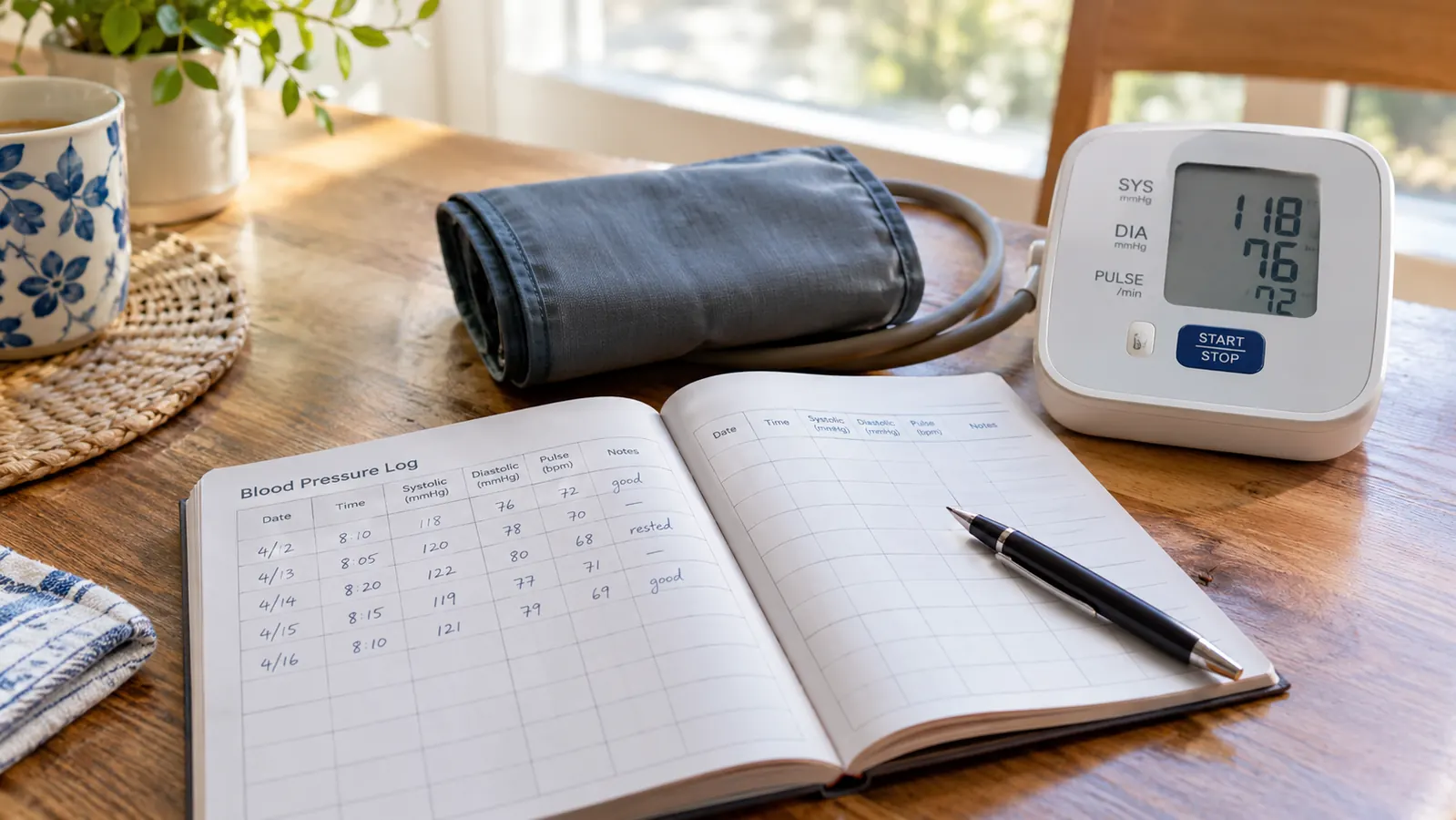
Here is what nobody tells you about keeping a blood pressure log on paper: the first book you pick will probably be the wrong one. I learned that the slow way, after my doctor asked me to take readings at home twice a day and bring in a log. I started with a spiral notebook, and that system kept falling apart within a few weeks. Dates wandered, numbers got squeezed into margins, and I could never find the entry from last Tuesday when the nurse asked about it. About eighteen months ago I switched to the Blood Pressure Log Book, and it is the first system that has actually stuck. This is the honest review I wish someone had handed me before I bought it, layout and page count included.
The Blood Pressure Log Book is exactly what the name says: a simple paper log for recording blood pressure readings. It is 110 pages, measures 6 by 9 inches, weighs about 6 ounces, and is independently published. There is nothing fancy about it. No charts to fill in, no graphs, no weekly summary pages, no place to paste your monitor's manual. It is a book of blank entry lines, and whether that sounds perfect or disappointing probably tells you whether this is the log for you.
The Quick Verdict
A no-frills paper log that finally made my twice-daily habit stick. If you want a place to write date, time, both numbers, pulse, and a note, this does it better than anything I tried. If you want charts, averages, or app-style insights, it will leave you cold.
Amazon Check Today's Price →The log that finally got my morning and evening readings into one tidy book
After eighteen months of daily use, the Blood Pressure Log Book is still the first thing I reach for at the kitchen table. If a simple paper log matches how you like to track, it is worth a look.
Amazon Check Today's Price on Amazon →How I've Used It
I am Ruth, I am 63, and I want to be clear that I am not a doctor or a nurse. I started checking my blood pressure at home about two and a half years ago after a routine checkup showed readings higher than my doctor liked. She asked me to take readings twice a day, morning and evening, for a few weeks and to bring her a log. I kept the habit, and the log became the centerpiece of it. I have used the Blood Pressure Log Book for about eighteen months now, long enough to know its quirks the way you know the quirks of a favorite chair.
I read at the kitchen table, same chair every time, feet flat on the floor, arm resting on the table at heart level, after five quiet minutes. Most mornings I take a reading on the OMRON Bronze upper-arm monitor, and most evenings I use the Withings BPM Connect. Then I open the log and write down the date, the time, both numbers, my pulse, and a short note about how I felt or what I had done in the hour before. That note is the part I did not expect to matter, but it is the part my doctor actually reads.
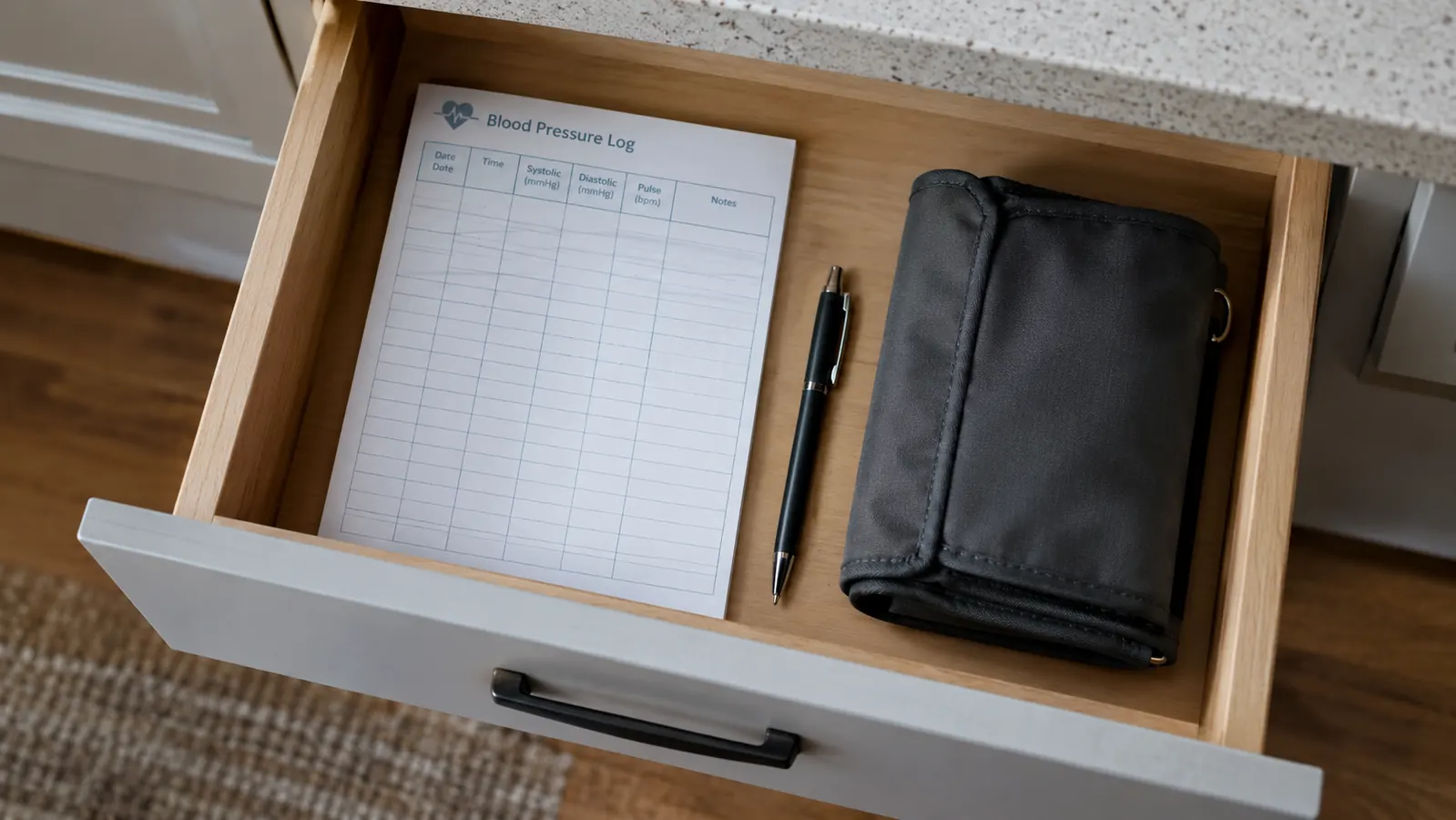
The book sits in the kitchen drawer between the monitor's pouch and a stack of napkins. It comes out twice a day, every day, and it goes back the same way. I bring it to every appointment, and my doctor flips to the most recent pages, looks at the pattern, and asks about anything unusual. The book does not interpret anything. It does not tell me whether a reading is good or bad. It just holds the record so my doctor can do the interpreting, and that division of labor has kept me honest for eighteen months.

What the Listing Does Not Tell You
This is the honest part, and it is why I am writing this at all. The listing tells you the page count and the dimensions, and that is about it. It does not tell you what the pages actually look like, and the layout is the whole product. If you are trying to decide between this book and a phone app, or between this book and a fancier journal, the inside pages are the only thing that matters.
The Blood Pressure Log Book gives you a clean line for each entry: date, time, both numbers, pulse, and a short note. That matches exactly what my doctor asked me to record. The lines are spaced so a normal pen writes comfortably, and I have never had trouble fitting a full sentence into the note space. For someone with my handwriting, that is the difference between a log I keep and a log I abandon by February.
What the listing also does not tell you is how the book behaves in real use. At 6 by 9 inches it sits flat on the kitchen table next to the monitor without taking over the whole surface. At 6 ounces it is light enough that I do not think twice about carrying it to an appointment. The pages lie flat enough to write in without holding the book open with my elbow, which matters when one hand is still in the cuff. None of that shows up in a product photo.
The Layout, Page by Page
I cannot show you a photo of the inside, so let me describe it the way I would at the kitchen table. The book is 110 pages of entry space. There is no complicated key at the front, no instructions I had to read twice, no legend explaining what column means what. You open it, you see where today's entry goes, and you write. For a person who is taking a reading with one arm and writing with the other, that simplicity is the whole point.
Each entry line is divided into the fields I mentioned: date, time, systolic, diastolic, pulse, and notes. I tested this against the way I actually record readings, and it matches. On the mornings I use the OMRON Bronze, the monitor shows both numbers and the pulse, and I copy them straight across. On the evenings I use the Withings BPM Connect, the same fields appear in the app, and I write them in the same order. The book does not care which monitor you use, which is exactly what I wanted.
The 110 pages last a good while at two entries a day, and because each entry has its own line, I never have to guess whether I skipped a day. Flipping back to find a specific date takes seconds. The book has no index, no tabs, no color coding, and I have never once wished it did. When I need last month's Tuesday evening reading, I know roughly where it is, and I find it in about ten seconds. That is the test that matters, and it passes.
How Long 110 Pages Actually Last
Let me do the math the way I did it when the book arrived. At two entries a day, one line per entry, 110 pages gives you a few months of entries before you need the next book. That sounded short to me at first, until I realized that my doctor wants to see a fresh, readable stretch of readings at each appointment, not a year of cramped pages. A book that fills up in two months is a feature, because it forces the record to stay current.
I keep the finished books in the kitchen drawer, each one labeled with the dates it covers. When my doctor asks how my numbers have been trending over the past season, I can pull the right book and flip to the right week in seconds. The page count is not a flaw. It is the reason the record stays useful instead of becoming an unreadable brick.
If you want a log that lasts a full year, you would need a book with more pages or fewer entries per page, and the Blood Pressure Log Book does not try to be that. It is honest about what it is: a two-month working record at twice-daily use. I would rather replace a book every few months than fight a crowded page that I cannot read back.
If you are weighing a paper log against an app, I have compared the two directly, and if you want the longer view of how this book behaves after a year of steady use, that review is here too. Both are worth reading before you decide.
What It Gets Right
First, it makes the habit visible. A book that lives in the kitchen drawer, opens flat, and has an obvious place for today's entry is a book that gets used. The spiral notebook failed because every page looked like every other page and I could never find anything. This book fails at none of that. The routine is the hard part of home blood pressure monitoring, and the layout supports the routine.
Second, it is honest about what it is. The Blood Pressure Log Book does not pretend to analyze your readings. It does not color code your numbers or tell you what they mean. That is a feature, not a missing one. My doctor is the person who interprets my numbers and decides about treatment. My job is to bring her a complete, readable record, and this book is built for exactly that job.
Third, the size works. Six by nine inches is small enough for the drawer and large enough that I never squint. Six ounces is light enough for the appointment bag. The dimensions sound like boring numbers in the listing, but they are the reason this book survived while the others did not. It does not announce itself, and it does not get in the way.
Of everything in the layout, the short note line is the part I would not give up. My doctor asked me to record the reading, but the note is what makes the reading understandable. When I write 'had coffee an hour before' or 'slept badly last night' or 'took a walk and felt calm', the numbers stop being abstract and start being a story. My doctor reads those notes carefully, and they have saved me from a lot of confused follow-up questions.
A phone app can hold the same information, and the Withings app does hold part of it. But the act of writing the note by hand is different. It takes three seconds, and it makes me pause and think about what the reading means in context. I did not expect a paper log to teach me anything about my own habits, but the note field is exactly where that happened.
Where It Falls Short
Now the part that the listing photos will not show you. If you want a log that does more than record, this is not it. There are no graph pages, no weekly or monthly summary pages, no place to calculate averages, no prompts to remind you to take your reading. The Blood Pressure Log Book is a record, not a coach. If you need a product to keep you on schedule, this one will not do that.
If you are the kind of person who wants to see trends at a glance, you will end up drawing your own little charts in the margins, which is exactly what I do about once a month. It works, but it is not what the book is for. I also keep the Withings app for the automatic side of things, and the app gives me the averages and the trend lines that the paper book does not. The paper book and the app are not competitors. They do different jobs, and I use both.
One more honest note: the book is plain. The cover is nothing special, the pages are functional, and there is no pleasure in the object itself. I do not care about that, but I know people who buy a nice notebook partly because they enjoy opening it. If you need the object to feel good, this one will not do that for you. It is a tool, and it looks like a tool.
What I Liked
- 110 pages of clean, single-line entries that match exactly what my doctor asked me to record
- 6 by 9 inches and 6 ounces, small enough for the kitchen drawer and light enough for an appointment bag
- Pages lie flat enough to write in with one hand still in the cuff
- No learning curve: open, write, close
- Works with any monitor, upper-arm or wrist, OMRON or Withings
Where It Falls Short
- No graph, summary, or average pages, so you cannot see trends at a glance
- Plain presentation with no pleasure in the object itself
- Independently published, so the cover and finish are basic
- If you already keep a phone app, a second paper record can feel redundant
The Blood Pressure Log Book does not interpret a single reading. It just holds the record so my doctor can, and after eighteen months that turns out to be exactly what I needed.
Who This Is For
If your doctor has asked you to bring in a log, and you want something you will actually keep up for more than three weeks, the Blood Pressure Log Book is a strong fit. It is for people who like writing things down by hand, who want the record to exist outside a phone, and who do not need the book to tell them what the numbers mean. It is for the person who, like me, sits at the kitchen table twice a day and wants the next empty line to be obvious.
It is also for people who bring a paper record to appointments because that is what their doctor actually looks at. My doctor has never once asked to see my phone. She asks to see the book. The Blood Pressure Log Book makes that moment easy, because the entries are legible, chronological, and complete.
Who Should Skip It
Skip it if you already track in an app and the app is working for you. Skip it if you want charts, averages, or any kind of analysis built into the book itself. Skip it if you need a beautiful object to stay motivated. And if you are hoping the log will lower your blood pressure, skip it for a different reason: a monitor measures and a log records, and neither one treats or lowers anything. That work belongs to your doctor, and the log is just your part of the conversation.
The log that finally stuck, after 18 months of twice-daily entries
If a simple paper record sounds like your system, the Blood Pressure Log Book is the one I still reach for every morning and evening after eighteen months. It is not fancy, and that is the point. Check today's price and see if the layout matches how you like to track.
Amazon Check Today's Price on Amazon →