If you have been told to track your blood pressure at home, you will face a small decision that sounds easier than it is: paper log or phone app. I have kept a written log for about two and a half years, since my doctor asked me to take readings twice a day and bring them to my appointment, and for the last year I have also used a phone app. I own the Blood Pressure Log Book, a 110-page paper log that sits in my kitchen drawer, and I use the Withings app on my phone most evenings. Both work. They do not work in the same way, and which one suits you depends on how you read, where you sit, and what your doctor actually wants to see.
The short answer: keep the paper log as your record, use the app as a convenience, and do not let either one become the reason you skip a reading. The Blood Pressure Log Book wins for people who want one clear page per entry, no phone in hand, and something to hand to the doctor. A phone app wins for people who want averages, trends and charts without doing any arithmetic. Here is what I learned from using both.
The paper log I keep in my kitchen drawer
After a year of using both, the Blood Pressure Log Book is the one I reach for every morning and the one I bring to my appointments. It is simple, it never needs charging, and it keeps every reading in one place.
Amazon Check Today's Price on Amazon →How I Used Both for a Year
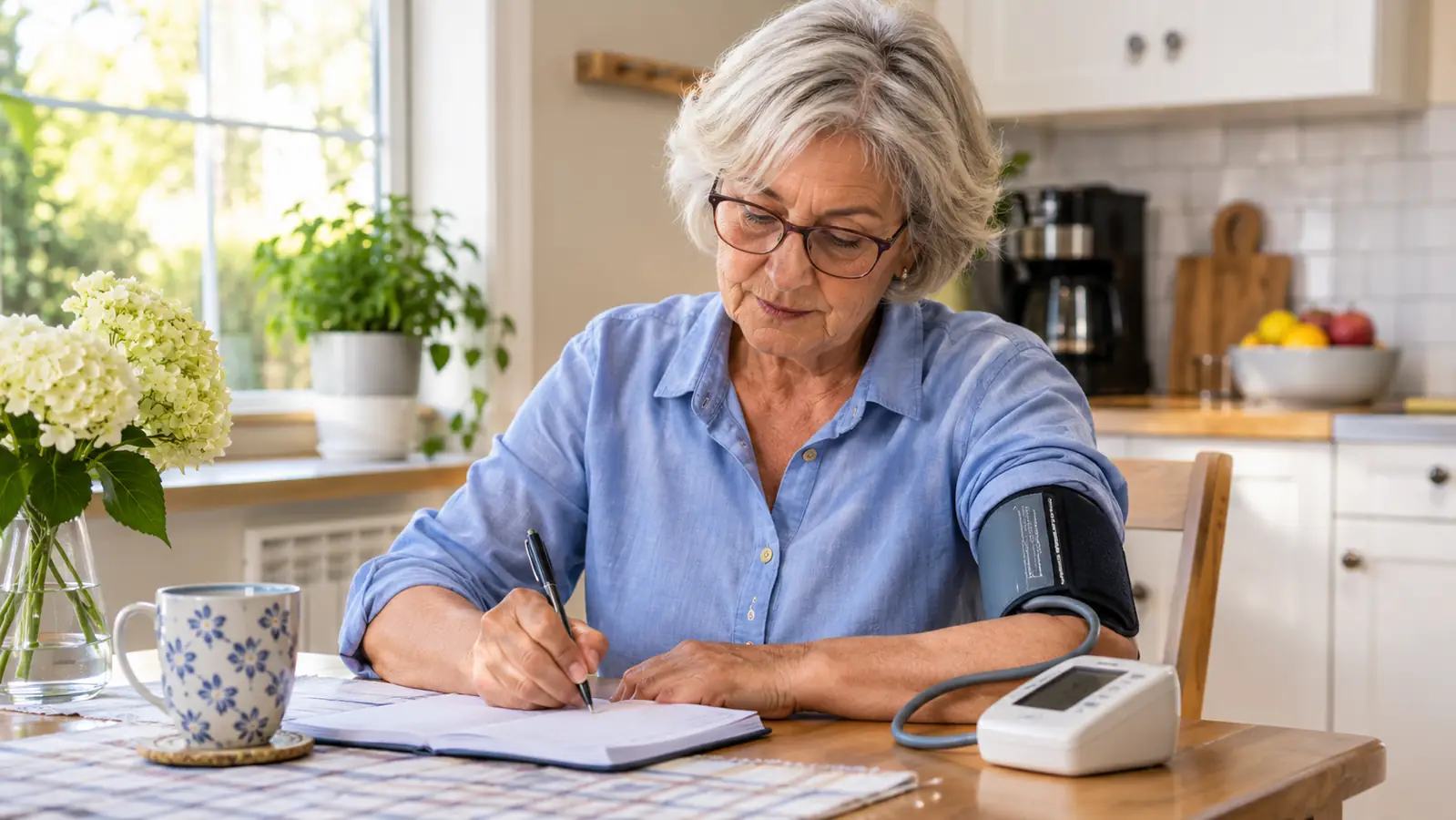
My setup is plain. Every morning I use my OMRON Bronze upper-arm monitor at the kitchen table, in the same chair, feet flat, arm resting on the table at heart level, after five quiet minutes. I take one reading and write it down. Most evenings I use the Withings BPM Connect, which sends readings to my phone, and I still write those down in the paper log too. So for about a year I have been recording the same kind of information two ways: once in ink, once in the app.
I did not start this way. For the first year I kept everything in a spiral notebook, and it was a mess: entries went in every direction, I skipped days because I could not find the page, and twice I brought the notebook to my doctor with whole weeks missing. The morning I gave up on it, I had taken my reading, set the pen down, and then spent five minutes hunting for the page because the last entry was upside down in the margin. About eighteen months ago I bought the Blood Pressure Log Book, and the difference was immediate. Every day has a row of its own, in order, and there is no place for the record to fall apart. The habit finally stuck because the book made the record legible.
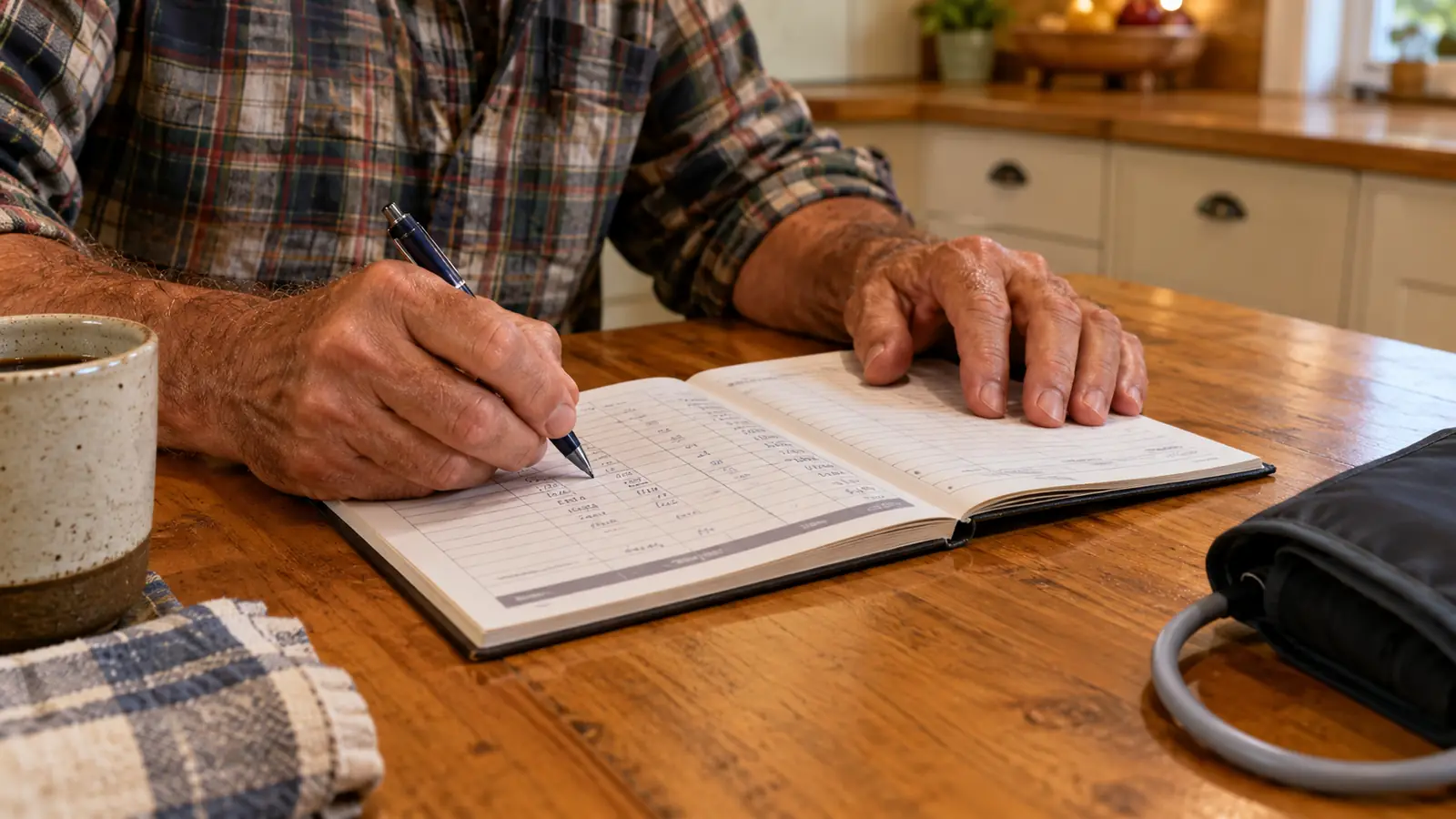
The Blood Pressure Log Book gives me a tidy page for each day: date, time, both numbers, pulse, and a short note. The note is the part I did not expect to value. On a bad morning I can write slept badly or had coffee before I remembered, and that context stays with the numbers. The app records the numbers perfectly and the context hardly at all. I can type a note in the Withings app, but I rarely do, because typing a sentence on a phone at 6:40 in the morning is more friction than picking up a pen.
What the app does better is the view. It draws a trend line, shows a seven-day average, and quietly does all the arithmetic I would otherwise do in my head. When my doctor asked me to watch whether my morning readings were drifting upward, the app answered that question in about ten seconds. The paper log answered it too, but I had to flip pages and do the math myself.
Where the Blood Pressure Log Book Wins
The paper log wins on trust. It cannot lose a reading to a sync failure, a dead battery, or an app update. It cannot be accidentally cleared. When I open the drawer and see the log, I know exactly what is in it: every reading I have taken since I bought it, in order, in my own handwriting. That matters more than it sounds like it matters. A log you trust is a log you actually keep.
It also wins at the doctor's office. I bring the Blood Pressure Log Book to every appointment. My doctor flips through it, sees the date, time, both numbers and my short notes, and can read the whole picture in a minute. Showing a doctor a phone screen works, but it means handing over my phone and scrolling, and the doctor still cannot see my notes the same way. The paper log is the thing I hand over without hesitation.
At my last appointment, my doctor spent a quiet minute on the log, then pointed at one entry and asked about the note I had written beside it, something about a poor night's sleep. That one exchange told me the notes were doing real work. A screen would have shown the same numbers, but the note, in my own hand, next to the number, is what made the visit feel like a conversation about me rather than a spreadsheet. I have never once handed my phone to a doctor and felt that the phone was the better record.
The third win is the one I did not expect: the paper log keeps me honest about the habit. Writing by hand takes twenty seconds and it makes the reading feel finished. The app, for all its convenience, makes the reading feel like data. Both get the number down. Only the paper log makes me feel like I have actually done the thing my doctor asked me to do.
Where Phone Apps Win
The app wins on time and arithmetic. The Withings app takes the reading from the monitor, stores it, and shows me a trend line without me lifting a pen. If you take readings twice a day for weeks, that convenience is real. It is also the only way I know to get a seven-day average without doing it yourself.
The app wins on portability in a different sense. I keep my OMRON Gold wireless wrist monitor in my travel bag for trips to see my daughter in San Antonio, and when I travel, the app is where the readings land. I still write them in the paper log when I get home, but during the trip the app is the record. If you travel often, or if you simply like seeing your numbers on a screen, the app is the better daily companion.
Last spring I spent a long weekend in San Antonio, and the routine worked better than I expected. I took my readings in the guest room, sitting on the edge of the bed with my feet flat and my arm on the nightstand, and each one appeared in the app before I had the cuff off. No pen, no book, no risk of leaving the log on the kitchen table at home. When I got back to Round Rock I copied the whole weekend into the paper log, which took about two minutes, and the permanent record stayed complete. That is the honest division of labor: the app carries the trip, the paper log holds the history.
The honest caveat: the app is only as good as the monitor it talks to, and it is one more thing that can fail. I have had a morning when the monitor would not connect to the phone, and I took the reading, wrote it in the paper log, and moved on. That morning the app was a nuisance and the paper log was the record. The app never replaces the log; it just makes the logging easier most days.
| Blood Pressure Log Book | Phone App (Withings) | |
|---|---|---|
| Permanent record | Every reading in ink, in order, cannot be lost to a sync failure | Readings stored on the phone, lost if the app fails or the phone dies |
| Handing it to the doctor | Flip open the book, hand it over, doctor reads the whole picture | Hand over the phone and scroll, notes not visible the same way |
| Notes and context | A short handwritten note on each entry, coffee, sleep, stress | Typing a note on a phone at 6:40 a.m. is friction, so I rarely do it |
| Trends and averages | I flip pages and do the arithmetic myself | Seven-day average and trend line drawn automatically |
| Travel | A book in a bag, easy to carry, needs no battery | Readings sync to the phone automatically during a trip |
| Daily friction | Pen to paper, about twenty seconds | Monitor connects, app opens, reading stores itself |

Where the Blood Pressure Log Book Wins
The biggest difference between the two is not the numbers, it is the feeling of the record. The Blood Pressure Log Book is a thing I can hold, flip through, and hand to my doctor. The app is a tool I use to see trends. After a year of keeping both, I reach for the paper log every morning and the app most evenings, and when I need to know how I have been doing, I look at the app.
If you are the kind of person who likes a clean page, a pen, and a record you can trust without wondering whether it synced, the Blood Pressure Log Book is the better choice. It does not need charging, it does not need a signal, and it does not need me to remember a password. It needs me to sit down, take the reading, and write it down. That is the whole job.
Where Phone Apps Win
To be fair, the app wins the parts of the job that are about seeing, not recording. The Withings app shows me a trend line, a seven-day average, and a chart of my morning readings without me doing any arithmetic. When I wanted to know whether my morning readings were drifting, the app answered in seconds. The paper log answered too, but only after I flipped pages and added numbers in my head.
The app also wins when I travel. I keep my OMRON Gold wireless wrist monitor in my travel bag for trips to San Antonio, and during those trips the app is where the readings land. I still write them in the paper log when I get home, but on the road the app is the record. If you travel often, or if you simply like seeing your numbers on a screen, the app is the better daily companion.
Start with the paper log, add the app later
If you are just starting to track at home, the Blood Pressure Log Book is the simplest place to begin. One page per entry, no setup, no syncing, and a record you can bring to your doctor. You can always add an app later if you want the trend lines.
Amazon Check Today's Price on Amazon →Who Should Buy Which
Buy the Blood Pressure Log Book if you want a permanent record you can hand to your doctor, if you like writing notes next to your numbers, or if you do not want your tracking to depend on a phone. Buy the phone app if you already have a monitor that syncs to it, if you want averages and trends without doing arithmetic, or if you travel and want readings to land somewhere automatically.
What I would tell you at my kitchen table: you do not have to choose. I use both, and using both is not double the work. The paper log is the record I trust and the app is the view I like. If you can afford one monitor and one log book, start there. The app can wait until you are sure the habit is sticking.
One more thing, and I mean it kindly: the tool matters far less than the sitting down. A monitor on a shelf measures nothing. I have missed mornings, and the reason was never the log or the app, it was me deciding the reading could wait. Last winter I let a whole week go by because I told myself the app had it covered, and at the end of the week I could not recall a single number without opening the phone. What finally worked was a fixed chair, a fixed time, and a book that made the entry feel finished. If a paper log does that for you, buy the paper log. If a phone app does it, buy the app. Just take the reading, write it down, and bring the record to your doctor.
Keep the record your doctor can actually read
After two and a half years of tracking at home, the Blood Pressure Log Book is the one I bring to every appointment. It is simple, it is complete, and it never depends on a battery or a signal.
Amazon Check Today's Price on Amazon →