
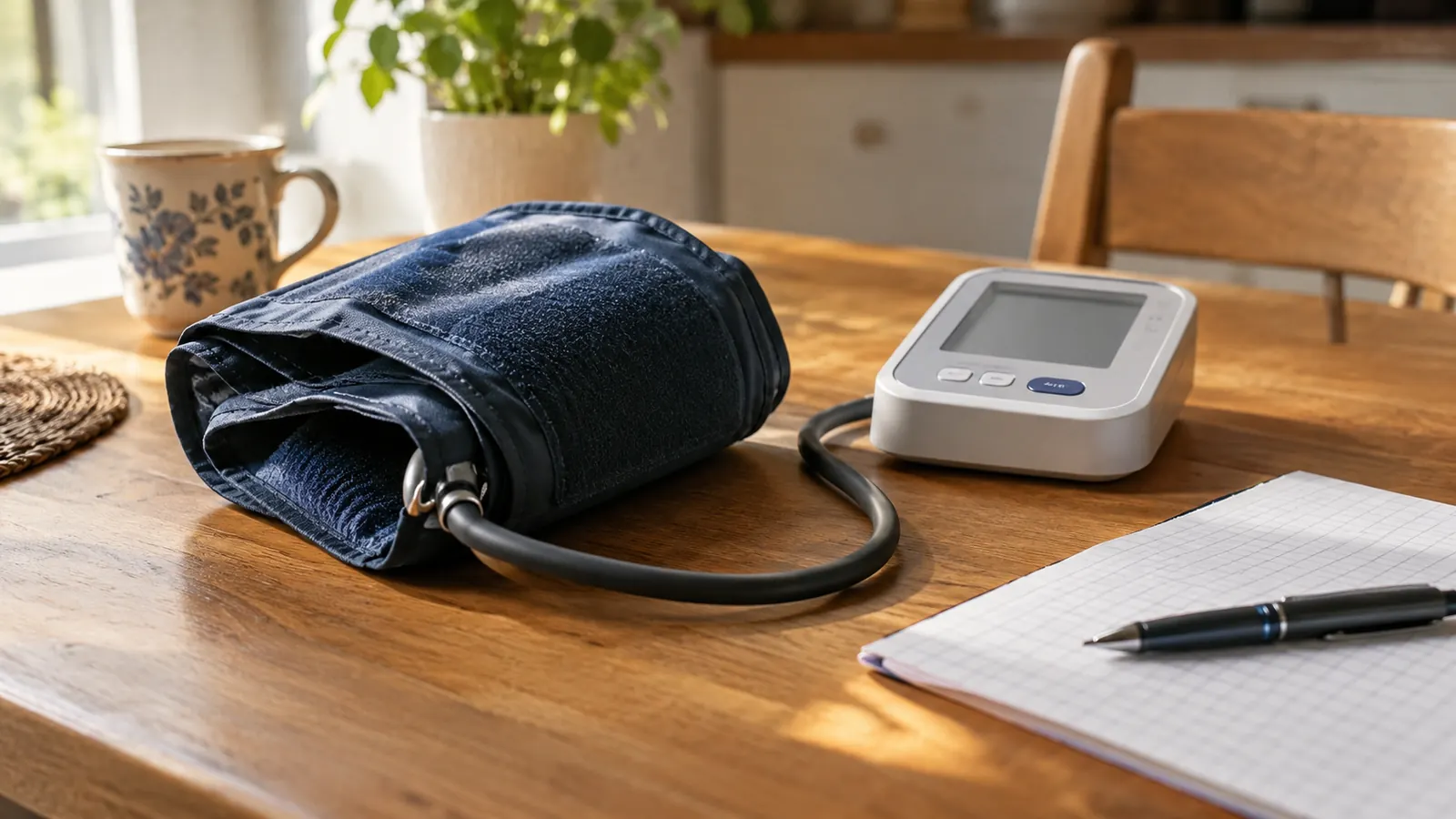
I am going to tell you something that surprised me about the Omron Large ComFit Cuff, and it is not what the product page leads with. I bought this cuff about eighteen months ago for my husband Walt, and I have watched him use it almost every morning since. The honest review is not really about the cuff itself. It is about the difference between a cuff that fits and a cuff that goes on right, and those are two very different things.
Before I go any further, I should say plainly that I am not a doctor or a nurse. I am a retired librarian who started checking her blood pressure at home about two and a half years ago, after a routine checkup showed readings higher than my doctor liked. My doctor asked me to take readings twice a day and bring in a log. I kept the habit, and along the way I learned more about cuffs than I ever expected to. Your own doctor is the one who interprets your numbers and decides on treatment. A monitor measures. It never treats or lowers anything, and I never want to imply otherwise.
The Quick Verdict
If your upper arm is anywhere in the 9 to 17 inch range and you struggle to wrap a standard cuff one-handed, this is the cuff that makes the monitor actually usable. It is not magic, it is not for everyone, and it will not fix a cuff that is the wrong size. But for Walt and me, it fixed the real problem, which was never fit at all.
Amazon Check Today's Price →The cuff that made our morning readings finally consistent
After eighteen months of daily use, the Omron Large ComFit Cuff is the reason Walt's readings stopped bouncing around. If wrapping a standard cuff one-handed has ever made you wonder whether your numbers are even right, this is the easy-wrap shape to try.
Amazon Check Today's Price on Amazon →How I've Used It
The Omron Large ComFit Cuff is the HEM-FL31-B, made for upper arms that measure 9 to 17 inches around. It is the cuff we use on our Omron Bronze upper-arm monitor, the one I use at the kitchen table every morning. Walt is 66, his arm measures about 15.5 inches, and he takes his own reading most mornings and writes it in our paper log with his initials. The cuff has been his for about eighteen months.
Here is the part that the product page does not tell you. The Bronze monitor's own included cuff also fits arms from 9 to 17 inches. Walt's arm fits both cuffs comfortably. We did not buy the ComFit because a cuff was too small or too tight. We bought it because Walt found the original cuff fiddly to wrap by himself. He kept putting it on too loose or too low, and then he would not trust the reading. The ComFit's easy-wrap shape goes on right more consistently, and it gave each of us our own cuff. I still use the original cuff. My arm is about 11 inches, and the original works fine for me.
Before the ComFit, Walt tried a generic, unbranded one-size universal cuff on the Bronze for a few weeks. It slipped, and his readings were all over the place. That is part of why we bought the ComFit in the first place. I mention it because it is the closest thing I have to a bad experience with this cuff, and it was really a bad experience with a different cuff entirely.
One morning last spring, I watched Walt put the original cuff on three times before he gave up and asked me to wrap it for him. First it was too loose, then it sat too low, almost on his elbow, and the third time he just stood there with the flat strip of fabric dangling. He is perfectly capable of wrapping his own arm. The problem was that the cuff would not stay where he put it while he pulled the tab with his other hand. That was the morning we started talking about a different cuff.
The first week with the ComFit, Walt still reached for it the old way, tugging and adjusting. By the second week he stopped thinking about it. He sits down, wraps the easy-wrap shape around his upper arm, pulls the tab, and the monitor starts to inflate the cuff. I timed him once out of curiosity: from picking up the cuff to the monitor starting to inflate it, about ten seconds. With the original cuff it was closer to two minutes, and half of that was second-guessing whether it was on straight.
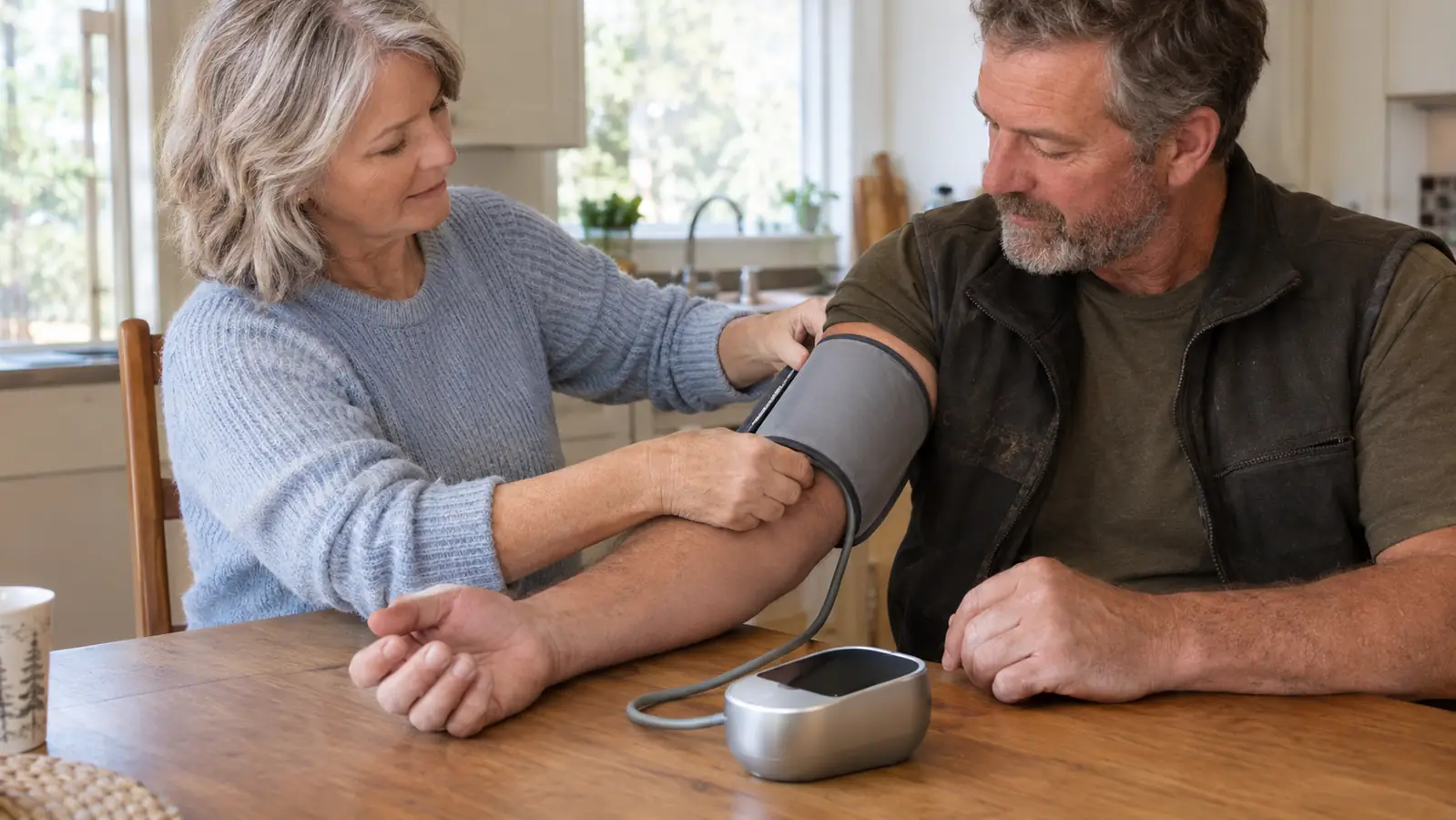
What Nobody Tells You About Fit
The first thing nobody tells you is that a cuff can fit your arm and still be wrong for you. Every cuff has a size range, and the ComFit's range is 9 to 17 inches. But the range only tells you that the cuff will wrap around your arm. It does not tell you whether you can wrap it correctly by yourself, one-handed, at 6:40 in the morning, before coffee. That is where the ComFit earns its keep.
The pre-formed shape is the whole story. A standard cuff is a flat strip of fabric that you have to hold in place while you pull the tab tight. If your other arm is the one being measured, you are doing this one-handed, and the cuff shifts. The ComFit is shaped to curve around your arm before you even fasten it, so it stays put while you pull the tab. Walt went from fussing with the cuff for two minutes to having it on and ready in about ten seconds. That is not an exaggeration. I have watched him do it hundreds of times.
When I measured Walt's arm, I used a cloth tape measure at the widest part of his upper arm, and it came to 15.5 inches. That is squarely in the middle of the ComFit's range, and it is also squarely in the middle of the original cuff's range. So the difference between the two cuffs was never about the numbers. It was about what happens between picking the cuff up and starting the monitor. Too loose, and the cuff does not hold the artery snugly. Too low, and it measures closer to the elbow, where the reading can come out differently. Walt knew all of this. He just could not get the flat strip to cooperate.
The second thing nobody tells you is that the cuff is not a universal accessory. It is compatible with specific Omron monitor models: the BP5250, BP7350, and BP7450. If you have a different monitor, even a different Omron model, you need to check compatibility before you buy. The air plug has to match your monitor's port. I have never tried it on anything but the Bronze, so I cannot tell you from experience how it behaves elsewhere. What I can tell you is to check your monitor's model number before you add this to your cart.
The third thing is the one that made me laugh when I figured it out. The ComFit is not a larger cuff. It is an easier cuff. The name 'Large' refers to the size range, 9 to 17 inches, which is the same range as the Bronze's included cuff. If you are buying this because you think your arm is too big for the cuff that came with your monitor, check the included cuff's range first. It may already fit you, and the ComFit is about convenience, not size.
I will also tell you what I tell everyone who asks about this cuff: the easy-wrap shape does not do the whole job. You still have to position the cuff so the air hose runs down the inside of your arm, and you still have to sit still while the monitor does its work. The cuff makes the wrapping easier. It does not make the measuring automatic.
The ComFit is not a larger cuff. It is an easier cuff. The size range is the same as the cuff that came with our monitor; what changed was how consistently it goes on.
How It Holds Up Over Time
Eighteen months is a long time for anything that gets handled twice a day, and this cuff has been handled a lot. Walt uses it on the Bronze most mornings, and I stick with the original cuff. It still fastens firmly, the pre-formed shape has not gone limp, and the air plug still clicks in securely. I have not had to replace it, and I do not expect to anytime soon.
The one thing I am careful about is the tube. The cuff has an air hose that connects to the monitor, and I have learned to store the cuff with the hose loosely coiled rather than folded sharply. That is just common sense with any cuff, and it is not a criticism of this one. The included components are the cable and the cuff itself, plus an instruction manual, and the whole thing weighs about 7.76 ounces. It is light enough that I keep it in the kitchen drawer with our log book when it is not in use.
The manufacturer backs it with a one-year limited warranty. We are past that now, and I have not needed it. I mention the warranty because it tells you something about how long a cuff is expected to last. A cuff is a wearing part. It will eventually need replacing, and that is normal. The question is whether it gives you consistent readings for a good long while, and ours has.
Omron lists travel as one of the cuff's features, and at 7.76 ounces and about 6.6 by 4.1 by 3.4 inches it would disappear into a side pocket. In our house it stays home on the Bronze, though, because the Bronze stays home too; on trips to San Antonio we bring the wrist monitor instead. I wipe the outside with a slightly damp cloth every few weeks, mainly because the kitchen drawer collects crumbs, and I never submerge it or fold the hose back on itself.
The fastener still grips the way it did on day one. If anything, the fabric has softened slightly, which makes the easy-wrap shape go on even more easily. I check the air plug before each use out of habit, and it has never loosened.
What I Liked
- Easy-wrap shape stays put while you fasten it one-handed, which is the whole point if you take your own readings
- Same 9 to 17 inch range as the Bronze's included cuff, so it fits most upper arms comfortably
- Compatible with three Omron monitor models: BP5250, BP7350, and BP7450
- Light at 7.76 ounces and easy to pack, so the routine travels well
- Gave Walt and me our own cuffs, so neither of us readjusts for the other's arm
Where It Falls Short
- Not a larger cuff despite the 'Large' in the name; check your included cuff's range before you buy
- Only works with specific Omron models, so the air plug has to match your monitor's port
- A convenience, not a necessity; if your current cuff goes on fine, you may not need this one
- Still demands a proper routine: right placement, arm at heart level, and five quiet minutes

Who This Is For
This cuff is for you if you take your own blood pressure at home and you have ever caught yourself wondering whether the cuff was on straight. It is for people who measure their own arm, one-handed, and who want the cuff to hold its position while they fasten it. It is for couples who share a monitor and want their own cuffs so they are not readjusting the same one twice a day. And it is for anyone with an arm in the 9 to 17 inch range who wants a cuff that goes on the same way every single time.
It is also for people who are serious about their log. I fill in the date, the time, both numbers, my pulse, and a short note every time I take a reading, and Walt does the same with his initials. A cuff that goes on consistently matters because it removes one more variable from the reading. When the numbers change, I want to know it is because my body changed, not because the cuff was crooked.
I would add one more group: people who share a monitor and are tired of readjusting the cuff between users. Before we bought the ComFit, one of us would take a reading and leave the cuff fastened, and the other would have to loosen it, re-wrap it, and wonder whether the first person's tug had stretched something out of shape. That is a small thing, but it is the kind of small thing that makes a habit easier to keep. Now each of us has our own cuff, and neither of us has to think about the other's arm size before taking a reading. Walt reaches for the ComFit, I reach for the original, and the monitor does not care which one is plugged in.
Who Should Skip It
Skip it if you are happy with the cuff that came with your monitor and it goes on fine every time. The ComFit is a convenience, not a necessity, and if your current cuff is working, you do not need this one. Skip it if your monitor is not one of the compatible models, because the air plug will not match and the cuff will be useless to you. And skip it if you are buying it because you think your arm is too large for your current cuff without checking the size range first. Measure your arm, check your included cuff's range, and then decide.
I would also gently say that no cuff fixes a bad measurement routine. The cuff is one part of the picture. I still sit in the same chair at the kitchen table, feet flat, arm resting on the table at heart level, after five quiet minutes. That routine matters as much as the cuff. If you are not doing the basics, the fanciest cuff in the world will not give you trustworthy numbers.
The Honest Bottom Line
I have been using the Omron Large ComFit Cuff for eighteen months, and I would buy it again. It did not change my readings, and I did not expect it to. What it changed was the ritual. Walt stopped fighting with his cuff, his readings stopped bouncing around, and our mornings got calmer. That is a real benefit, even if it is not the one the product page leads with.
One more honest note. I have read reviews from people who expected the ComFit to change their numbers, and I understand the hope. A cuff that fits properly can absolutely change what the monitor reports if your old cuff was the wrong size. But if your cuff already fits, a new cuff will not lower or raise anything. What it can do is make you trust the reading you get. That trust matters, because a reading you do not believe is a reading you will not log, and a log with gaps is not a log your doctor can use.
If you are in the 9 to 17 inch range and you have ever suspected that your cuff was on crooked, this is worth trying. It is the rare accessory that makes the thing it attaches to work better. And if you are not sure whether it fits your monitor, check the model number first. That is the honest advice I would give anyone at my kitchen table.
Make your morning readings one less thing to doubt
After eighteen months of daily use, the Omron Large ComFit Cuff is the reason our readings finally stopped varying with the cuff. If your arm is in the 9 to 17 inch range and your current cuff never seems to go on straight, this is the easy-wrap shape to try.
Amazon Check Today's Price on Amazon →