

About two and a half years ago, my doctor asked me to take my blood pressure at home twice a day and bring in a log. I am Ruth Pembrook, a retired middle-school librarian in Round Rock, Texas, and I have sat down at my kitchen table every morning and evening since. The monitor does the measuring, but the cuff does the fitting, and I have learned that the cuff matters more than most people expect. This is my long-term review of the Omron Large ComFit Cuff, after about eighteen months of daily use in our house.
The short answer to the question in the title is yes, cuff size and fit can change your readings, sometimes by a lot. A cuff that is too loose, too tight, or wrapped crooked will give you numbers you cannot trust, and no monitor can fix that. The Omron Large ComFit Cuff, model HEM-FL31-B, fits upper arms 9 to 17 inches and is the easiest way I have found to get a consistent fit on my husband Walt's arm. It is not a fancy gadget. It is a well-made cuff that wraps the same way every time, and that consistency is the whole point.
The Quick Verdict
If you share a monitor, or you struggle to wrap a cuff one-handed, this is the easiest way to get consistent readings. It will not lower your numbers, but it will make the numbers you get worth trusting.
Amazon Check Today's Price →A cuff that wraps right the first time, every time
The Omron Large ComFit Cuff fits upper arms 9 to 17 inches and works with the OMRON Bronze, BP5250, BP7350, and BP7450 monitors. If you have ever retaken a reading because the cuff felt crooked or loose, this is worth a look.
Amazon Check Today's Price on Amazon →How I've Used It
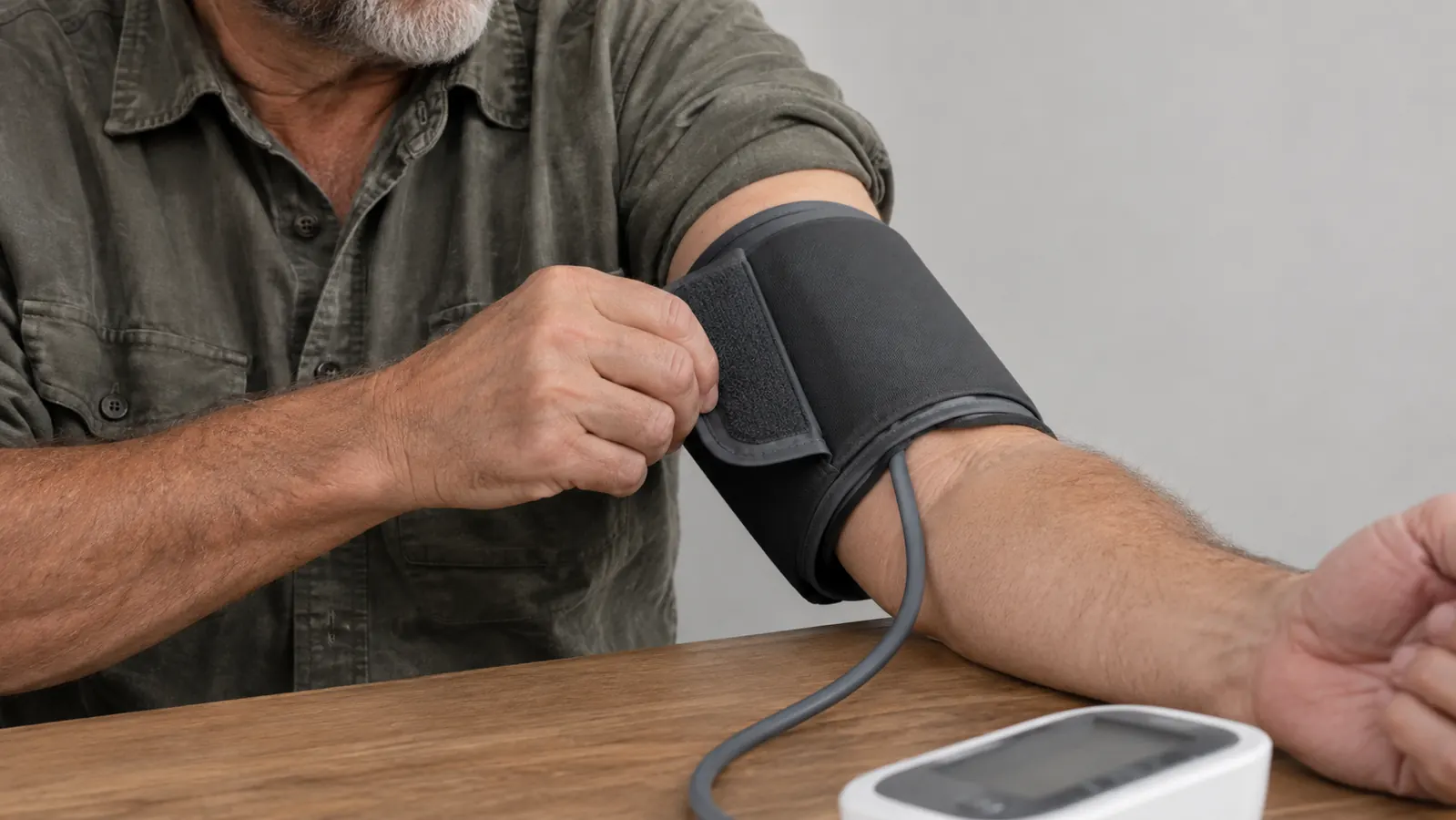
Walt and I have used the Omron Large ComFit Cuff for about eighteen months. It lives on our OMRON Bronze upper-arm monitor, which stays in the kitchen drawer between readings. Most mornings Walt takes his reading first, sitting in the same chair I use, feet flat on the floor, arm resting on the table at heart level, after five quiet minutes. He wraps the ComFit cuff himself, one-handed, and that was the entire reason we bought it.
Before the ComFit, Walt used the cuff that came with the Bronze. That cuff also fits 9 to 17 inch arms, so it was never a size problem. The problem was the wrapping. Walt's arm is about 15.5 inches, and he found the original cuff fiddly to wrap by himself. He would put it on too loose, or too low, or with the tubing twisted, and then he would get a reading that did not match how he felt, and he would start over. Some mornings he took three readings before he trusted one.
The ComFit changed that. Its pre-formed, easy-wrap shape goes on right more consistently, so Walt can wrap it with one hand and get a reading he trusts on the first try. I still use the original cuff that came with the Bronze, because my arm is about 11 inches and I have never had trouble with it. Having our own cuffs also means we are not readjusting the fit back and forth between two different arms twice a day. That alone removed a surprising amount of small frustration.
Why Cuff Fit Changes Your Readings
Here is what I understand from my own experience and from reading the manual that came with our monitor. A blood pressure monitor measures the pressure inside the cuff and then estimates your blood pressure from that. If the cuff is too small, too loose, or sitting in the wrong spot, the monitor is measuring something different from what it is supposed to measure. The manual for our monitor says the cuff should be snug but not tight, and I have found that is easier said than done with some cuffs. Garbage in, garbage out, as we used to say in the school library.
A cuff that is too small for your arm can read high, because the monitor has to squeeze harder. A cuff that is too loose can read low or give you a number that makes no sense. A cuff that slips while it inflates can stop the reading entirely. The Omron Large ComFit Cuff is designed for upper arms 9 to 17 inches, which covers most adults, but the range is only half of it. The fit is the other half, and the fit is where the ComFit earns its keep.
The pre-formed shape holds itself open as you wrap it, so it is much harder to put on crooked or loose without noticing. Walt's readings stopped bouncing around the morning he switched. I am not a doctor or a nurse, and I want to be plain about that. I am a retired librarian who takes readings twice a day and brings the log to her appointments. What I can tell you is what I have watched in my own kitchen: when the fit is consistent, the readings are consistent.
What You Get With the Omron ComFit Cuff
The Omron Large ComFit Cuff, model HEM-FL31-B, is a large cuff that fits upper arms 9 to 17 inches. It comes with an air plug and an instruction manual, and Omron lists it as compatible with the BP5250, BP7350, and BP7450 monitors. It is the cuff we use on our OMRON Bronze. The air plug is the same style our Bronze uses, so it clicks in without any force. The listing gives the package as 6.6 by 4.1 by 3.4 inches and about 7.76 ounces, which matches how light it feels in the hand.
The detail I notice every day is the shape. The ComFit is pre-formed, so it opens ready to wrap. You do not wrestle it flat, wrap it, and hope it stays. You slide your arm in, pull it snug, and it is basically in the right position. For Walt, who fought the original cuff every morning, that was the whole difference. It is a small design choice, and it is the one that matters.
Omron also lists travel as a special feature, and I believe it. It is light and small enough that it would take up almost no room in a bag, though in our house it stays home on the Bronze. The warranty is a one year limited warranty, which is the same kind of coverage we have come to expect from Omron. One honest note: the ComFit is a cuff, not a monitor. It has no display, no buttons, and nothing to sync. It only makes the readings from your monitor more trustworthy, because the fit is more consistent.
How It Performed Over Eighteen Months
Eighteen months of daily use is a fair test, and the ComFit has held up well. The fabric is still smooth, the pre-formed shape still holds, and the air plug still clicks in firmly. Walt has not once complained about it slipping mid-reading. I cannot say the same for the month or two he spent with a generic, unbranded universal cuff before I bought this one. I have no reason to think it will wear out before the monitor does.
That generic cuff taught us the lesson. It was a one-size-fits-all cuff with no brand name, and it slipped on Walt's arm. His readings were all over the place, and he started doubting the monitor itself. When I switched him to the Omron ComFit, the readings settled down. I am not claiming the monitor was wrong before and right after. I am saying that a cuff that moves around while it inflates will give you measurements you cannot trust, and no monitor can fix that.
My only small complaint is that the ComFit is a dedicated large cuff. It does not fit my 11 inch arm as naturally as the original cuff does, so I stick with the original. That means we keep two cuffs in the kitchen drawer, which is a tiny bit of clutter. If you are the only person using your monitor, you may not need the ComFit at all. If you share a monitor with someone whose arm is a different size, or who struggles to wrap a cuff one-handed, this is where it earns its place.

What I'd Tell Someone Starting Home Readings
If you are just starting, like I was two and a half years ago, here is what I wish someone had told me. Sit in the same chair every time. Put your feet flat. Rest your arm on the table at heart level. Sit still for five quiet minutes before you press start. Do not take a reading right after a stressful phone call. And check the cuff before you trust the number. A cuff that fits the same way every time removes one more thing to wonder about.
Keep a simple log. I use a paper log book in the kitchen drawer, and I write the date, the time, both numbers, my pulse, and a short note about how I felt. Walt writes his own readings in the same book with his initials. At every appointment, I bring the log to my doctor and let them do the interpreting. That is the part I never skip: the monitor measures, and my doctor decides what the numbers mean.
What I Liked
- Pre-formed, easy-wrap shape goes on right more consistently, even one-handed
- Fits upper arms 9 to 17 inches, covering most adults including larger arms
- Compatible with the OMRON Bronze, BP5250, BP7350, and BP7450 monitors
- Light and compact enough to travel, and Omron lists travel as a feature
- Held up well through eighteen months of daily use
Where It Falls Short
- It is a cuff only, not a monitor, so it adds nothing if your current cuff already fits well
- The 9 to 17 inch range overlaps with the Bronze's included cuff, so some households will not need it
- It only works with the compatible Omron monitor models, so check yours before buying
Walt's readings stopped bouncing around the morning he switched to the ComFit. A cuff that wraps the same way every time gives you readings you can actually bring to your doctor.
Who This Is For
The Omron Large ComFit Cuff is for you if you share an upper-arm monitor with someone whose arm is a different size than yours. It is for you if you have a larger arm and your current cuff feels tight or leaves a deep crease. It is for you if you struggle to wrap a cuff one-handed, or if you find yourself retaking readings because the cuff felt crooked. Walt's arm is 15.5 inches, and the ComFit wraps it without pinching or sliding. The pre-formed shape fixes that specific frustration.
It is also for you if you travel. It is small enough to disappear into a bag, though ours stays home on the Bronze. And if you are starting home readings because your doctor asked you to, a cuff that fits consistently is one less thing to wonder about while you sit at the kitchen table trying to get a good reading. Start with the cuff that came with your monitor. If it gives you trouble, the ComFit is the upgrade to consider.
Who Should Skip It
Skip the ComFit if you already have a cuff that fits well and wraps easily. The OMRON Bronze comes with a cuff that also fits 9 to 17 inch arms, so for many people the included cuff is all they need. I still use the original cuff myself. The ComFit is not a monitor upgrade. It does not measure anything on its own, and it will not change your numbers by itself. It only makes the measurements you already take more consistent.
Also skip it if your monitor is not one of the compatible Omron models, because the air plug connection needs to match. And if you prefer a wrist monitor, this cuff is not for you at all. It is for upper-arm monitors, period. If your monitor came with a cuff that fits, you may be better served by spending your money on a good log book. As always, bring your log to your doctor and let them interpret your numbers. I am not a doctor. I am just a woman who has taken a lot of readings at her kitchen table, and I can tell you the cuff matters more than I expected.
Give your readings a fair start
If you are retaking readings because your cuff slips or feels crooked, the Omron Large ComFit Cuff is the fix. It fits upper arms 9 to 17 inches and works with the OMRON Bronze, BP5250, BP7350, and BP7450. Your doctor is the one who interprets the numbers, but you can make sure the numbers are worth bringing.
Amazon Check Today's Price on Amazon →